
Medical Equipment Asset Lifecycle: When to Repair, Upgrade, or Replace
Medical Equipment Asset Lifecycle: When to Repair, Upgrade, or Replace
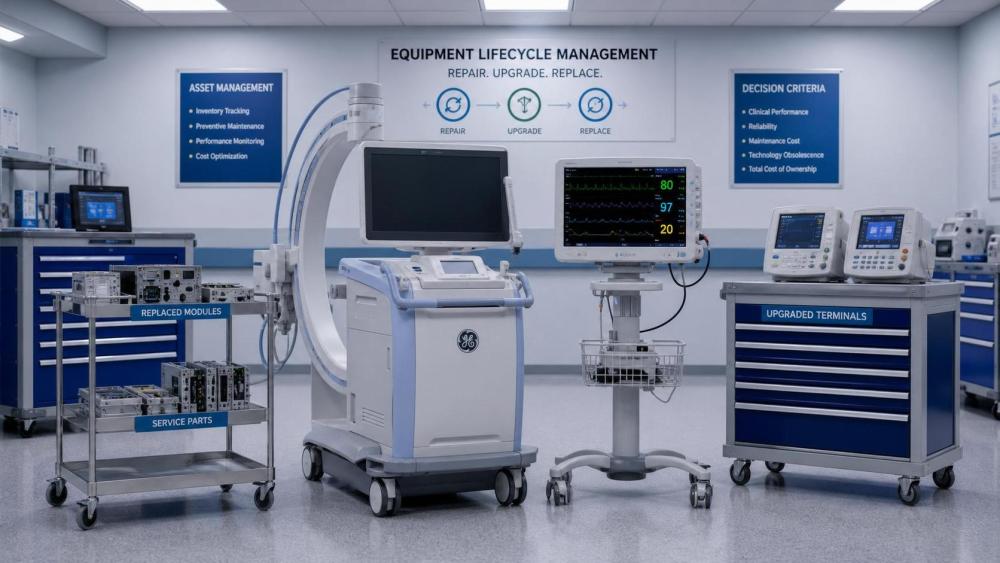
Managing the medical equipment asset lifecycle is a practical leadership issue, not only a technical one.
A delayed decision can raise downtime, service cost, and clinical risk.
An early replacement can also waste capital and disrupt procurement plans.
That is why a structured medical equipment asset lifecycle strategy matters.
For hospitals, distributors, and healthcare project planners, the question is rarely simple.
Should the device be repaired, upgraded, or fully replaced?
The answer depends on safety, performance, compliance, parts availability, and long-term operating value.
In real operations, these factors need to be reviewed together.
A device may still run, yet fail to support current workflow.
Another may appear outdated, but still deliver reliable value after a targeted upgrade.
Why the Medical Equipment Asset Lifecycle Deserves Executive Attention
The medical equipment asset lifecycle affects much more than maintenance budgets.
It shapes service continuity, patient safety, capacity planning, and procurement timing.
It also influences vendor negotiations and capital allocation.
From a business angle, poor lifecycle decisions often create hidden costs.
These include repeat service visits, idle staff time, delayed exams, and emergency rentals.
In imaging, one unstable scanner can affect scheduling for days.
In laboratories, aging analyzers can slow throughput and increase quality control pressure.
In critical care, older monitors or ventilators may create unacceptable operational risk.
Core factors that shape lifecycle decisions
- Clinical importance of the device
- Failure frequency and repair history
- Software support and cybersecurity status
- Spare parts and consumable availability
- Regulatory and documentation readiness
- Compatibility with current workflow and infrastructure
- Total cost of ownership over the next three to five years
When Repair Is the Right Choice
Repair is often the best option in the medical equipment asset lifecycle when the root issue is isolated.
This usually applies when the device remains compliant, accurate, and clinically relevant.
A single board failure, worn sensor, damaged cable, or power issue does not always justify replacement.
In many cases, repair protects cash flow and avoids unnecessary disruption.
Still, repair only makes sense when performance can be restored predictably.
Repair usually fits these situations
- Downtime is short and service response is reliable
- Parts are available from approved sources
- Calibration and validation can be completed quickly
- The failure does not involve repeated safety concerns
- Annual repair costs remain well below replacement cost
A practical benchmark helps here.
If annual maintenance and repair stay manageable, repair may still be justified.
But once repair becomes repetitive, the medical equipment asset lifecycle decision should be reopened.
When an Upgrade Delivers Better Value
An upgrade sits between repair and replacement.
It works best when the platform is stable, but the current configuration no longer meets operational needs.
This is common in imaging, laboratory automation, patient monitoring, and digital hospital systems.
Examples include software updates, detector changes, workstation refreshes, network integration, or feature expansion.
In the medical equipment asset lifecycle, upgrades often improve ROI without full capital replacement.
Strong signals that an upgrade may be enough
- The core hardware remains reliable
- Clinical users need faster workflow or better usability
- New standards require software, connectivity, or security updates
- Throughput needs have increased, but not dramatically
- The vendor offers validated upgrade paths with service support
This matters especially for organizations balancing several asset categories at once.
A selective upgrade can extend useful life while preserving funds for higher-risk equipment.
That makes the medical equipment asset lifecycle less reactive and more strategic.
When Replacement Becomes the Smarter Decision
Replacement is usually the hardest decision because it involves capital, planning, and change management.
Yet in the medical equipment asset lifecycle, delay can be more expensive than action.
The clearest signal is repeated failure combined with declining vendor support.
Another is when the device no longer supports current clinical demand.
A system may still operate, but slow workflow, unstable output, or poor compatibility can limit service capacity.
At that point, replacement is no longer optional planning. It becomes risk control.
Replacement is often justified when
- Service costs rise sharply year after year
- Critical parts are obsolete or hard to source
- Software is unsupported or vulnerable
- Accuracy, image quality, or throughput no longer meets expectations
- Compliance gaps cannot be solved through upgrade
- Operator training burdens continue to increase
Replacement also creates a chance to standardize fleets and simplify service contracts.
That broader value should be included in every medical equipment asset lifecycle review.
A Simple Evaluation Framework for Better Decisions
A clear framework reduces internal debate and makes vendor discussions more productive.
The medical equipment asset lifecycle should be reviewed with both technical and business criteria.
This kind of comparison keeps the medical equipment asset lifecycle grounded in evidence.
It also helps align procurement, finance, and clinical engineering around the same decision logic.
Common Mistakes That Distort Asset Decisions
The biggest mistake is judging value by purchase price alone.
In the medical equipment asset lifecycle, low initial cost can still lead to high lifetime expense.
Another mistake is waiting for a complete breakdown before planning replacement.
That usually forces rushed procurement and weakens negotiation leverage.
Some organizations also ignore training, software support, and documentation readiness.
Those factors often decide whether an asset remains usable in practice.
What to review before the final decision
- Check service records for repeat failures and downtime patterns.
- Review vendor support status, spare parts, and software roadmap.
- Confirm whether workflow gaps come from the device or the process.
- Compare repair, upgrade, and replacement over a multi-year horizon.
- Include validation, installation, training, and transition costs.
Turning Lifecycle Insight Into Better Procurement Planning
A strong medical equipment asset lifecycle process is not only about fixing aging devices.
It creates a more disciplined path for procurement and portfolio development.
When repair, upgrade, and replacement rules are defined early, decisions become faster and less emotional.
That supports better budgeting, clearer supplier evaluation, and stronger long-term value.
In practical terms, the best next step is to rank assets by criticality, support status, and cost trend.
Then match each device to the most realistic action path.
Some assets deserve repair and continued use.
Some need an upgrade to stay efficient and compliant.
Others have reached the point where replacement is the more responsible business decision.
Have questions about the global trade trends discussed here, or planning your expansion and supply chain strategy? Leave a message below and let the trade experts at MTHH guide you.
We respect your privacy. Your information is strictly confidential.
Related News
- Hong Kong Outlines Medical Device Legislation and Plans for Statutory RegulatorNov 14, 2026Hong Kong medical device legislation could reshape regulatory oversight. Explore the proposed regulator and what businesses should monitor.
- AAMI Issues TIR115 Guidance on Public Cloud Use in Medical DevicesNov 13, 2026AAMI TIR115:2026 guides public cloud use in medical devices. Explore its focus on risk management, supplier assessment and device boundaries.
- How are critical care devices regulated in the United States?Nov 12, 2026Critical care devices face FDA requirements based on intended use and risk. Explore classifications, marketing pathways, and practical compliance checks.
- Hong Kong Drafts Medical Device Bill to Establish Statutory OversightNov 12, 2026Hong Kong's Medical Devices Bill could introduce risk-based statutory oversight. Discover what the proposed framework may mean for suppliers.