
Medical Device Validation Process: Key Steps to Meet FDA and ISO Requirements
The medical device validation process is a critical foundation for quality teams and safety managers working to meet FDA and ISO requirements. From design controls and risk management to verification, documentation, and process consistency, every validation step directly affects compliance, product reliability, and patient safety. This article outlines the key stages, common challenges, and practical considerations that help organizations build a more effective and audit-ready validation strategy.
Why Quality and Safety Teams Cannot Treat Validation as a Final Checkbox
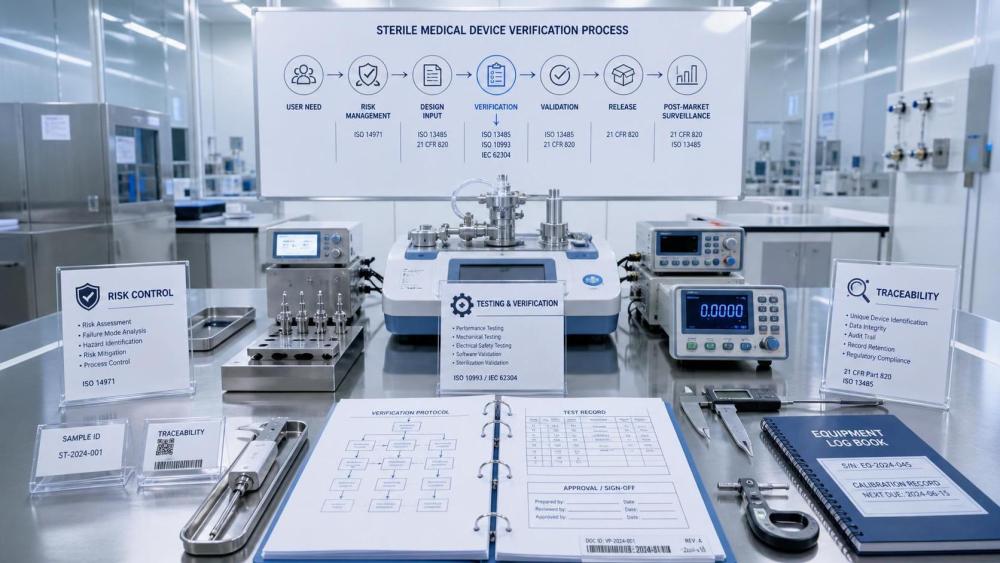
When people search for the medical device validation process, they usually want more than a textbook definition. They need to know what must be validated, when it must happen, and how to prove compliance.
For quality personnel and safety managers, the main concern is practical: how to meet FDA and ISO requirements without creating documentation gaps, release delays, or uncontrolled product risk.
The short answer is clear. Validation is not a single test at the end of development. It is a structured body of evidence showing that the device, software, and related processes consistently meet intended use.
Under FDA expectations and ISO 13485 quality system requirements, validation connects design inputs, risk controls, verification activities, process controls, and documented objective evidence. If any of these links are weak, compliance becomes difficult to defend.
This matters because medical devices operate in environments where failures affect diagnosis, therapy, infection control, workflow continuity, and patient outcomes. A weak validation strategy is therefore both a regulatory problem and a safety problem.
What Regulators and Auditors Actually Expect from the Medical Device Validation Process
FDA and ISO frameworks do not expect every manufacturer to follow one identical template. They do expect a documented, risk-based validation system appropriate to the device, its intended use, and its complexity.
For FDA-regulated products, quality teams usually work within design controls, process validation expectations, software validation principles, and broader quality system documentation. For ISO-focused systems, ISO 13485 and ISO 14971 are central reference points.
Auditors and inspectors generally look for consistent logic. They want to see how user needs became design inputs, how risks were identified, how controls were implemented, and how the final evidence supports safe and effective use.
They also expect traceability. If a device has a safety alarm, measurement function, sterility claim, connectivity function, or usability-sensitive feature, the validation file should show where that requirement originated and how it was confirmed.
In practice, validation is convincing when documentation tells one coherent story. Scattered reports, unsigned protocols, weak acceptance criteria, and inconsistent change records usually create more concern than the test result itself.
Start with Intended Use, User Needs, and Risk-Based Scope
One of the most common validation mistakes is beginning with test execution instead of validation scope. A sound medical device validation process starts with intended use, user environment, patient population, and foreseeable misuse.
Quality and safety teams should first ask which product characteristics are critical to safety, clinical performance, essential functionality, data integrity, and regulatory claims. That analysis determines the depth of validation required.
For example, a patient monitor, infusion pump, imaging workstation, or IVD analyzer does not carry the same validation burden in every function. High-risk features need deeper evidence than minor convenience features.
Risk management should therefore be integrated from the beginning, not added later. ISO 14971-style analysis helps teams identify hazardous situations, define risk controls, and determine which functions require stronger validation evidence.
This stage is where teams decide whether validation must cover product design, manufacturing processes, software tools, cleaning methods, sterilization processes, packaging performance, transportation conditions, or installation procedures.
A well-defined scope prevents two expensive outcomes: over-validation of low-risk issues and under-validation of critical features that later trigger nonconformities, complaints, or field actions.
Design Validation and Verification: Understand the Difference Clearly
Many organizations still blur verification and validation, which causes confusion during reviews and audits. Verification asks whether the device was built according to specified requirements. Validation asks whether it fulfills intended use in actual or simulated use conditions.
Both are necessary, but they answer different questions. Bench testing, electrical safety testing, software unit testing, dimensional checks, and protocol conformance often support verification activities.
Validation, by contrast, focuses on real-world suitability. It may include simulated clinical use, usability assessment, workflow testing, environmental performance, alarm response evaluation, and confirmation that the final device supports user needs safely.
For safety managers, this distinction matters because a device can pass verification and still fail validation. A feature may work exactly as designed yet remain unsafe, confusing, unreliable, or impractical in clinical use.
Strong teams maintain a requirements traceability matrix linking user needs to design inputs, verification methods, validation methods, risk controls, and final approval records. This is one of the most efficient tools for audit readiness.
Process Validation Is Essential When Output Cannot Be Fully Verified Later
Another critical part of the medical device validation process involves manufacturing and support processes. Regulators expect process validation where the output cannot be fully verified through inspection or routine testing alone.
Common examples include sterilization, sealing, welding, molding, bonding, cleaning, aseptic processing, and some software-driven production steps. In these cases, process consistency itself must be demonstrated and controlled.
Quality teams often use IQ, OQ, and PQ structure to organize evidence. Installation Qualification confirms the equipment and setup are correct. Operational Qualification challenges operating ranges. Performance Qualification confirms reliable output under normal conditions.
What matters most is not the labels, but the logic. Teams must show the process was developed with defined parameters, worst-case conditions, acceptance criteria, trained personnel, calibrated equipment, and controlled records.
Safety managers should pay close attention to processes affecting biocompatibility, sterility assurance, contamination control, and device reliability. A manufacturing process failure can become a patient safety event even when the design itself is sound.
Software Validation Has Become a Core Compliance Requirement
For modern devices, software validation is no longer a specialized side topic. It is often central to safety, performance, cybersecurity, interoperability, and data accuracy. This applies to embedded software and quality system software alike.
Teams should validate software according to intended use, risk class, and failure impact. That means defining software requirements clearly, testing expected and unexpected conditions, documenting anomalies, and controlling changes after release.
Quality system software used in production, inspection, complaint handling, or document control also needs appropriate validation. If the system can affect product quality or records integrity, regulators expect objective evidence that it performs as intended.
Weak software validation usually appears in predictable ways: vague requirements, missing challenge tests, poor version control, unresolved defects, and no documented rationale for accepting known residual issues.
Because many medical devices now rely on connectivity, interfaces, and digital workflows, software validation should also consider user permissions, alarm handling, time synchronization, data transfer accuracy, and failure recovery behavior.
Documentation Must Be Structured for Traceability, Review, and Defense
Validation is only credible when evidence is documented in a clear, reviewable structure. A strong file typically includes plans, protocols, approved acceptance criteria, raw data references, deviation handling, summary reports, and final conclusions.
For quality control teams, the challenge is not simply generating more records. It is making sure documents are complete, linked, approved, and internally consistent across development, manufacturing, and post-market quality systems.
Each validation activity should answer five basic questions: what was tested, why it was tested, who approved the method, what acceptance criteria applied, and whether the result supports intended use and risk control.
Documentation gaps often create bigger inspection problems than technical failures. If deviations were handled informally, test conditions were unclear, or retesting occurred without justification, the credibility of the entire validation package can weaken.
This is especially important for contract manufacturing, multi-site production, and distributor-supported installations. Responsibilities for generating, reviewing, approving, and retaining evidence must be assigned in writing.
Change Control and Revalidation Are Where Many Systems Break Down
Even companies with decent initial validation often struggle after design changes, supplier changes, software updates, or production transfers. Yet regulators expect validation to remain current throughout the product lifecycle.
A practical change control system should assess whether a change affects safety, performance, labeling claims, materials, interfaces, production parameters, cleaning procedures, or user interaction. If it does, revalidation may be required.
Not every change needs full repeat validation. However, teams must document the rationale for partial testing, equivalence decisions, or no-test conclusions. Unsupported assumptions are difficult to defend during audits.
Safety managers should watch closely when changes involve alarms, dose-related behavior, measurement algorithms, sterilization loads, packaging materials, or environmental operating limits. These changes can introduce risk even when they seem minor operationally.
Post-market data should also feed revalidation decisions. Complaints, service records, nonconformities, CAPA trends, and field feedback often reveal process weaknesses that were not visible during initial validation.
Common Validation Failures and How to Prevent Them
Most validation failures are not caused by lack of effort. They come from poor sequencing, weak ownership, and incomplete risk thinking. Teams start testing before requirements are stable, or they write protocols after work has already begun.
Another common problem is using generic acceptance criteria that do not reflect clinical use, device claims, or operating conditions. Criteria must be specific, measurable, and justified by standards, risk files, or user requirements.
Cross-functional gaps also cause trouble. Engineering, quality, manufacturing, regulatory, and service teams may each hold part of the evidence, but nobody owns the complete validation story from requirement to release.
To prevent this, organizations should define stage-gate reviews, traceability ownership, deviation workflows, and approval responsibilities early. A validation master plan is often useful for complex products or facilities.
Training matters as well. Personnel must understand not just how to execute a protocol, but why the protocol exists, what risk it addresses, and what makes the evidence acceptable under FDA and ISO expectations.
How to Build a More Audit-Ready Validation Strategy
For quality professionals and safety managers, the most effective validation strategy is disciplined, risk-based, and lifecycle-oriented. It starts early, stays tied to intended use, and evolves with product and process changes.
In practical terms, that means defining scope before testing, separating verification from validation, aligning work with risk management, validating critical processes, controlling software changes, and maintaining strong traceability.
It also means reviewing validation not as an isolated quality function, but as an operational control that protects product performance, supports regulatory submissions, and reduces downstream quality costs.
When validation is done well, it improves more than compliance. It reduces rework, prevents release delays, strengthens supplier oversight, supports smoother audits, and gives hospitals, distributors, and end users greater confidence in device reliability.
For organizations operating in competitive medical technology markets, that confidence becomes part of the product’s commercial value. Buyers and partners increasingly look for evidence that quality systems are mature, not merely documented.
Conclusion
The medical device validation process is ultimately about proving consistency, safety, and intended performance with objective evidence. FDA and ISO requirements may differ in wording, but both demand a structured, risk-based, well-documented approach.
For quality control personnel and safety managers, the strongest path is to treat validation as a continuous system rather than a closing formality. The organizations that do this well are usually better prepared for audits, product changes, and market growth.
If the goal is reliable compliance and safer device deployment, validation should begin with user needs, stay anchored in risk, and end with documentation that can withstand technical and regulatory scrutiny.
Have questions about the global trade trends discussed here, or planning your expansion and supply chain strategy? Leave a message below and let the trade experts at MTHH guide you.
We respect your privacy. Your information is strictly confidential.
Related News
- FDA Issues Benefit-Risk Discussion Paper on Robotic Medical DevicesNov 07, 2026Explore the FDA discussion paper on robotic medical devices, its potential benefit-risk implications, and what manufacturers and purchasers should monitor.
- How to select ISO standards for medical device performance evaluationNov 06, 2026Choose medical device performance evaluation ISO standards with confidence. Learn to match claims, test methods, and regulatory requirements to reliable evidence.
- FDA Updates QMSR FAQs and Medical Device Cybersecurity GuidanceNov 06, 2026FDA QMSR FAQs and medical device cybersecurity guidance: Explore potential implications for ISO 13485 alignment, compliance planning and supplier coordination.
- Philips Reaches €288 Million Settlement in US Respiratory Device Recall ProbeNov 05, 2026Philips reaches a €288 million US settlement over its respiratory device recall. Explore the financial impact and implications for manufacturers.