
Medical Device Market Access in the Middle East: 5 Approval Risks to Check Early
Medical device market access Middle East planning often looks straightforward at the commercial stage, then slows sharply during approval review. The region offers strong demand across imaging, diagnostics, patient monitoring, hospital infrastructure, and infection control, yet each market applies its own rules, documentation expectations, and local registration processes.
That gap matters early. A launch model may appear commercially sound, but a missed approval detail can affect timeline, distributor readiness, service setup, and procurement credibility. In practice, the strongest evaluations start by checking approval risks before pricing, channel expansion, or tender preparation moves too far.
Why early approval review matters in the region
The Middle East is not a single regulatory block. Gulf markets may share broad healthcare modernization goals, but registration routes, evidence thresholds, import conditions, and post-market expectations still differ country by country.
For that reason, medical device market access Middle East decisions should be treated as a market-by-market assessment, not a regional shortcut. This is especially relevant for equipment linked to clinical risk, software functionality, consumable dependency, or installation requirements.
The issue is not only legal approval. Delays in registration can also disrupt hospital project schedules, warehouse planning, training programs, warranty activation, and service response commitments.
A visual checkpoint can help frame the topic.
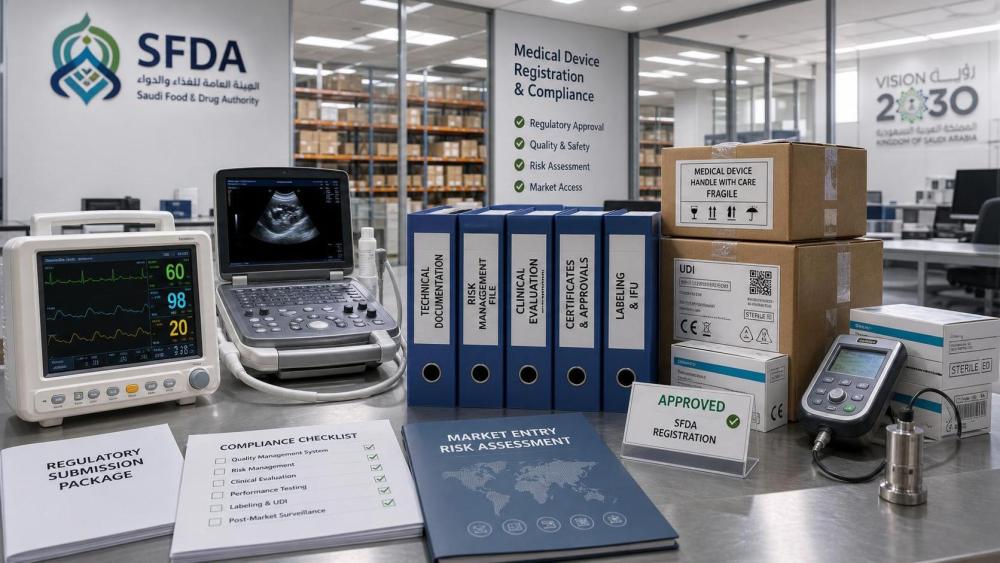
Platforms such as MTHH are useful in this stage because market access is closely tied to technical performance, safety documentation, maintenance reality, and long-term operating value. For medical technology, approval review and commercial evaluation are rarely separate tasks.
Risk 1: Assuming one registration pathway fits every country
One common mistake is treating prior approval in the US, EU, or another reference market as enough for regional entry. It helps, but it does not remove the need to verify local registration structure.
Some authorities rely more heavily on reference approvals. Others focus more closely on local submission format, importer status, Arabic labeling, legal documentation, or in-country representation.
This becomes more sensitive when the portfolio includes several product families, software-enabled systems, or accessories sold under one commercial package. What looks like a single product commercially may require multiple regulatory reviews.
Early checks should clarify:
- whether the target country uses manufacturer registration, product registration, or both
- whether reference market certificates are mandatory, supportive, or insufficient alone
- whether listing changes if the product is sold through a local distributor
- whether installation, calibration, or service capability affects approval timing
Without this mapping, commercial forecasts for medical device market access Middle East projects can become too optimistic from the start.
Risk 2: Overlooking the role and legal position of local representation
Local representation is often treated as an administrative item. In reality, it can shape submission eligibility, document control, import authority, vigilance communication, and even future channel flexibility.
In some markets, the local agent or distributor becomes the practical gatekeeper for registration status. That arrangement may work well initially, but it creates risk if portfolio priorities change, service quality drops, or exclusivity becomes restrictive.
This is particularly important for devices requiring regular maintenance, spare parts planning, user training, or consumable continuity. Clinical equipment is not just imported once; it must remain operational through service, updates, and documentation support.
A sound early review should examine the operating implications of representation, not only the contract signature.
For medical device market access Middle East work, representation should be evaluated as part of channel strategy, operational control, and compliance resilience.
Risk 3: Submitting technical documentation that is complete on paper but weak in practice
Documentation gaps do not always mean missing files. More often, the problem is inconsistency between product claims, labeling, risk files, intended use, clinical support, and service information.
This matters across many categories covered by MTHH, from ultrasound and patient monitors to sterilizers, IVD systems, infusion devices, and digital hospital tools. Different technologies trigger different evidence needs, but the same principle applies: the submission must describe the product exactly as it will be marketed and supported.
Typical weak points include software version mismatch, unclear accessory relationships, incomplete IFU alignment, and unsupported performance statements. If a product depends on reagents, disposables, detectors, probes, or network integration, those dependencies should be reflected clearly.
A useful review lens is to ask whether the technical file also supports real procurement questions. Hospitals and distributors usually need confidence on installation conditions, operator training, maintenance intervals, consumable supply, warranty scope, and long-term service readiness.
When those points remain vague, approval may slow down, and commercial trust often weakens at the same time.
Risk 4: Misreading product classification and regulatory scope
Classification errors are expensive because they affect almost everything after them. The wrong class can lead to the wrong evidence package, the wrong submission timeline, or a failed expectation for local review.
This issue appears often in borderline products. Software linked to diagnosis, connected monitoring platforms, combination kits, reusable surgical tools, and laboratory systems with dedicated reagents can fall into more complex scopes than expected.
It also affects non-obvious items in hospital infrastructure. Sterilization systems, medical gas components, emergency equipment, cleanroom-related devices, and certain furniture categories may trigger requirements that differ from standard procurement assumptions.
In medical device market access Middle East evaluations, classification should be confirmed against local interpretation, not only global internal labels. Even when the core device class seems settled, accessories and bundled items may still change the filing path.
Questions worth checking early
- Is the product a standalone device, an accessory, or part of a system?
- Does software create a higher regulatory expectation?
- Are consumables or reagents regulated separately?
- Could local language or labeling rules alter the marketed configuration?
Risk 5: Underestimating country-specific compliance after registration
Approval is only one step in medical device market access Middle East execution. After registration, country-specific compliance continues through import controls, labeling updates, adverse event reporting, renewal timelines, warehousing rules, and post-market documentation.
Business cases often fail here because teams assume the major work ends once the certificate arrives. For capital equipment and clinically sensitive devices, the opposite is often true. Operational compliance begins to matter more once the device enters tenders, installations, and routine use.
This is highly relevant for products that need calibration, preventive maintenance, software patches, or recurring consumable supply. A regulator may approve the product, but hospitals will still judge whether the whole support model is credible.
That is why MTHH-style evaluation is useful beyond regulation alone. It connects approval thinking with technical support, lifecycle cost, service continuity, and clinical workflow compatibility.
How to use these checks in business evaluation
A practical review does not need to be complicated. It needs to be structured early enough to influence go-to-market decisions before commitments harden.
Useful next steps include:
- build a country comparison sheet for registration pathway, timelines, and local representation rules
- test technical files against marketed claims, accessories, software versions, and service promises
- confirm product classification locally for each device family and bundled component
- review post-registration obligations alongside logistics, training, and maintenance plans
- align regulatory assumptions with commercial milestones such as tenders, pilot sites, and distributor launch timing
The broader point is simple. Medical device market access Middle East success depends less on late-stage correction and more on early clarity. When approval risk is reviewed together with technical, operational, and channel realities, market entry becomes more predictable and easier to defend internally.
Before advancing a regional plan, it is worth pressure-testing the first assumptions: which countries come first, which products are truly registration-ready, which partner model protects future flexibility, and which support commitments can be sustained after approval. Those answers usually shape better entry decisions than headline demand alone.
Have questions about the global trade trends discussed here, or planning your expansion and supply chain strategy? Leave a message below and let the trade experts at MTHH guide you.
We respect your privacy. Your information is strictly confidential.
Related News
- Hong Kong Outlines Medical Device Legislation and Plans for Statutory RegulatorNov 14, 2026Hong Kong medical device legislation could reshape regulatory oversight. Explore the proposed regulator and what businesses should monitor.
- AAMI Issues TIR115 Guidance on Public Cloud Use in Medical DevicesNov 13, 2026AAMI TIR115:2026 guides public cloud use in medical devices. Explore its focus on risk management, supplier assessment and device boundaries.
- How are critical care devices regulated in the United States?Nov 12, 2026Critical care devices face FDA requirements based on intended use and risk. Explore classifications, marketing pathways, and practical compliance checks.
- Hong Kong Drafts Medical Device Bill to Establish Statutory OversightNov 12, 2026Hong Kong's Medical Devices Bill could introduce risk-based statutory oversight. Discover what the proposed framework may mean for suppliers.