
Medical Device Market Access Cost: What Drives Budget and Approval Timelines
Medical Device Market Access Cost: What Drives Budget and Approval Timelines
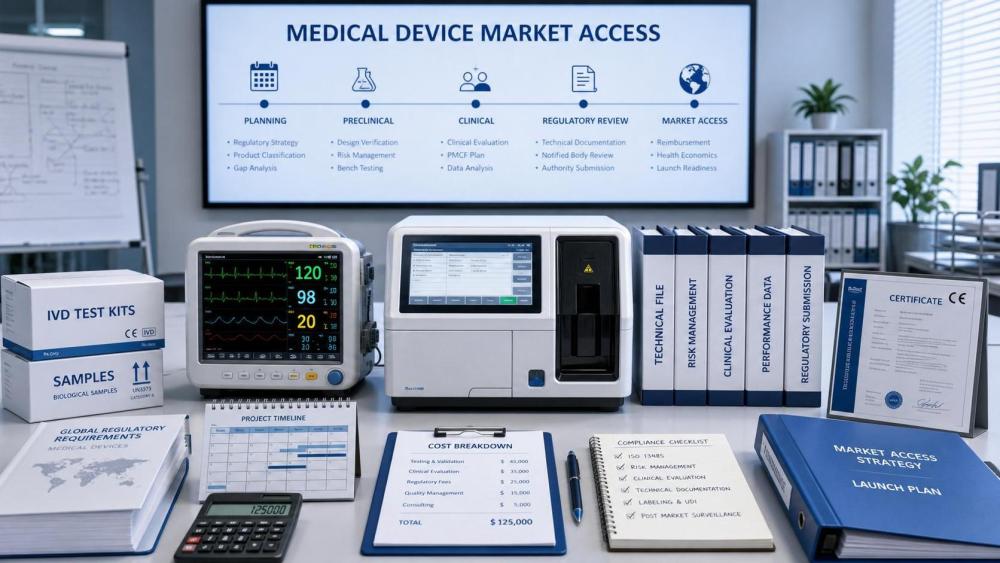
Understanding medical device market access cost is essential when approval speed affects revenue timing, distributor confidence, and internal capital planning.
A lower quoted registration fee rarely reflects the full cost of entering a healthcare market.
In practice, budget pressure usually comes from document preparation, evidence gaps, local representation, testing, and timeline drift.
That is why medical device market access cost should be reviewed as a cross-functional investment, not a single compliance line item.
For finance and approval teams, the key question is simple: what actually drives cost, and what makes timelines expand?
The answer usually starts with market scope, product risk class, and the amount of technical proof already available.
A patient monitor, imaging system, IVD analyzer, or sterilization device may face very different pathways, even within the same region.
This also means budget forecasts improve when teams separate fixed filing costs from variable readiness costs.
Why Medical Device Market Access Cost Is Often Underestimated
Many early forecasts focus on official submission fees because they are visible and easy to quote.
However, those fees are only one part of medical device market access cost.
The larger spend often appears before submission.
Teams may need to update technical files, translate labeling, align claims, verify standards, and close quality documentation gaps.
If the target country requires local testing or in-country representation, the budget rises again.
A second source of underestimation is time.
When approval takes longer than planned, commercial launch, training, tender participation, and distributor onboarding are delayed.
That delay creates an indirect medical device market access cost through lost market opportunity and extended operating overhead.
From a budgeting perspective, that hidden cost can be more serious than the registration invoice itself.
The Main Budget Drivers Behind Market Entry
Most medical device market access cost models can be broken into five working categories.
This structure makes budget review easier and supports faster internal approval.
1. Regulatory pathway complexity
Higher-risk devices usually require more evidence, deeper review, and more formal interaction with regulators or notified bodies.
The difference between Class I and Class III can change both budget and timing dramatically.
2. Clinical and performance evidence
If existing studies are incomplete, outdated, or not accepted locally, companies may need fresh evaluation work.
That can quickly become a major medical device market access cost driver.
3. Technical documentation readiness
Incomplete risk files, inconsistent intended use statements, or weak software documentation often lead to rounds of questions.
Each round adds consulting hours, internal labor, and timeline pressure.
4. Localization requirements
Translations, local labeling rules, importer registration, and country-specific templates add real cost.
These tasks look administrative, but they often decide whether approval moves smoothly.
5. Post-market obligations
Vigilance reporting, complaint handling, field safety readiness, and document maintenance continue after approval.
So medical device market access cost should always include launch-year support, not just pre-approval activity.
What Usually Extends Approval Timelines
Long approval cycles are rarely caused by one issue alone.
More often, several small readiness problems combine into a slow review process.
From recent market behavior, the clearest signal is that documentation quality now matters as much as submission timing.
- Device claims are broader than the available evidence.
- Labeling and IFU language differ from technical file statements.
- Software, cybersecurity, or usability files are incomplete.
- Test reports do not match the latest design version.
- Local agents respond slowly during authority questions.
- Quality system records are not ready for review.
Each issue may look manageable on its own.
Together, they increase medical device market access cost by forcing rework and delaying launch revenue.
For capital planning, timeline risk should therefore be priced as a budget variable, not treated as a separate operational concern.
A Practical Cost Framework for Financial Review
A useful review model divides medical device market access cost into direct, indirect, and contingent spending.
This helps decision-makers avoid approving a budget that covers only the obvious items.
This framework makes medical device market access cost easier to compare across countries and product categories.
It also supports clearer discussion with regulatory, quality, and commercial teams before funds are released.
How to Reduce Cost Without Weakening Compliance
Controlling medical device market access cost does not mean choosing the cheapest path.
It means improving readiness before avoidable delays begin.
- Map target markets by revenue value, risk class, and pathway complexity before filing decisions are locked.
- Run a document gap review against local requirements, not only home-market files.
- Check whether clinical, performance, and software evidence matches current claims and device configuration.
- Build a timeline with review cycles, translation time, and authority questions already included.
- Reserve contingency funds for relabeling, testing updates, and local procedural changes.
- Link approval milestones to commercial readiness so launch value is measured realistically.
In actual operations, early readiness work often costs less than late-stage correction.
That is one of the most reliable ways to protect both approval speed and total market entry return.
What Approvers Should Ask Before Releasing Budget
Before approving a medical device market access cost plan, several questions help expose hidden risk.
- Is the pathway confirmed for each target market?
- Which documents already exist, and which must be created or updated?
- Are clinical and performance claims fully supported?
- What local testing, translation, or representation is mandatory?
- What is the expected cost of one quarter of launch delay?
- Who owns post-market compliance after approval?
These questions shift the discussion from fee approval to investment control.
They also improve confidence that medical device market access cost is connected to actual commercial timing, not just paperwork completion.
Final Takeaway
Medical device market access cost is shaped by more than registration fees.
The real budget outcome depends on pathway complexity, evidence strength, documentation readiness, localization work, and post-market responsibility.
Approval timelines follow the same logic.
When readiness is weak, cost rises and launch value slips.
When teams review medical device market access cost through a full investment lens, planning becomes more accurate and market entry becomes more dependable.
The practical next step is to build a country-by-country cost model, test it against document readiness, and price timeline risk before approval funds are committed.
Have questions about the global trade trends discussed here, or planning your expansion and supply chain strategy? Leave a message below and let the trade experts at MTHH guide you.
We respect your privacy. Your information is strictly confidential.
Related News
- FDA Issues Benefit-Risk Discussion Paper on Robotic Medical DevicesNov 07, 2026Explore the FDA discussion paper on robotic medical devices, its potential benefit-risk implications, and what manufacturers and purchasers should monitor.
- How to select ISO standards for medical device performance evaluationNov 06, 2026Choose medical device performance evaluation ISO standards with confidence. Learn to match claims, test methods, and regulatory requirements to reliable evidence.
- FDA Updates QMSR FAQs and Medical Device Cybersecurity GuidanceNov 06, 2026FDA QMSR FAQs and medical device cybersecurity guidance: Explore potential implications for ISO 13485 alignment, compliance planning and supplier coordination.
- Philips Reaches €288 Million Settlement in US Respiratory Device Recall ProbeNov 05, 2026Philips reaches a €288 million US settlement over its respiratory device recall. Explore the financial impact and implications for manufacturers.