
IEC 62304 for Medical Device Software: Key Documentation and Risk Control Steps
IEC 62304 sits at the center of medical software review because software now influences diagnosis, therapy, alarms, workflow, and device connectivity across healthcare settings.
For any team assessing development quality, medical device software IEC 62304 offers a practical lens for checking whether safety controls are planned, documented, and maintained.
That matters well beyond software companies alone. Imaging systems, patient monitors, IVD platforms, infusion devices, and hospital digital infrastructure increasingly depend on reliable software lifecycles.
In procurement and technical review, incomplete records often signal broader gaps in design discipline, change control, cybersecurity readiness, or post-market support.
Why IEC 62304 matters in real healthcare projects
Medical technology purchasing is rarely about hardware alone. A system may look strong on specifications, yet still create risk if its software process is weak.
Medical device software IEC 62304 is the lifecycle standard widely used to structure software development, maintenance, risk linkage, problem resolution, and configuration control.
It does not certify clinical performance by itself. Instead, it helps show whether software work was performed under a controlled and traceable process.
That distinction is important when evaluating products for hospitals, laboratories, distributors, or cross-border market entry.
Platforms such as MTHH are useful in this context because buyers and technical reviewers need structured information, not only brochures or feature lists.
A credible software file supports broader decisions around safety, service readiness, training demands, and long-term operating value.
What the standard really covers
A common misunderstanding is that IEC 62304 is only a documentation exercise. In practice, it is a process framework tied to real engineering decisions.
Medical device software IEC 62304 covers software development planning, requirements, architecture, detailed design, unit work, integration, testing, release, maintenance, and problem handling.
The standard also requires linkage to risk management. Software cannot be reviewed in isolation from hazardous situations and possible patient harm.
Another core element is safety classification. Software items are typically considered under Class A, B, or C based on possible injury impact.
Higher safety impact means stronger expectations for evidence, verification depth, and control discipline.
Lifecycle areas usually reviewed
- Development planning and assigned responsibilities
- Software requirements and design outputs
- Verification, validation support, and acceptance criteria
- Configuration management and version control
- Problem resolution, anomaly tracking, and maintenance updates
- Traceability between hazards, controls, implementation, and test evidence
Key documentation that signals process maturity
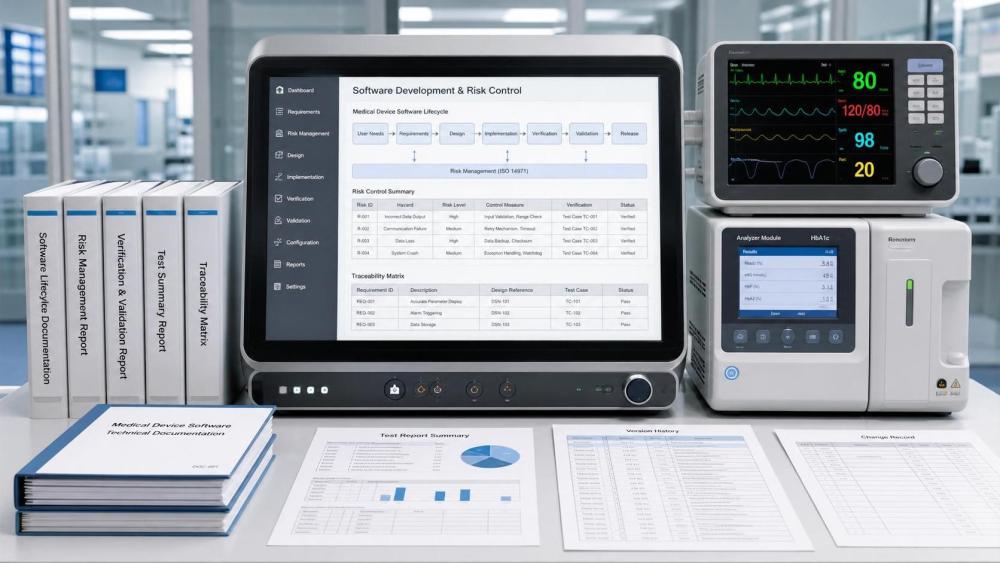
When reviewing medical device software IEC 62304, the strongest indicator is not one isolated file. It is the consistency between multiple controlled records.
A polished requirements document means little if risk controls never appear in architecture, code review, or test results.
The table below highlights records that usually deserve early attention.
In many evaluations, traceability is the make-or-break factor. If a requirement cannot be traced to design, risk control, and test evidence, confidence drops quickly.
Risk control steps that deserve close attention
IEC 62304 does not replace ISO 14971, yet effective use of medical device software IEC 62304 depends on strong risk management integration.
The practical question is simple. When software can contribute to harm, where is that risk identified, controlled, verified, and maintained?
Typical control path
- Identify software-related hazardous situations and contributing failures
- Define risk control measures in requirements or architecture
- Implement controls with version-controlled design outputs
- Verify control effectiveness through test evidence
- Assess residual risk and unresolved anomalies before release
- Maintain the same discipline during updates and field corrections
Examples vary by product category. In a patient monitor, risk controls may involve alarm logic, sensor disconnection detection, and data integrity.
In diagnostic imaging, they may involve dose-related settings, image reconstruction reliability, or interface protection between workstation and modality.
For IVD systems, focus often falls on result calculation, calibration handling, reagent identification, and sample tracking.
These are not abstract compliance issues. They affect clinical trust, downtime risk, and acceptance during installation or audit.
Where evaluators often find gaps
Many software files appear complete at first glance, yet problems emerge once documents are compared across the lifecycle.
Several recurring issues deserve extra scrutiny when reviewing medical device software IEC 62304.
- Safety classification is declared, but the rationale is weak or missing
- Software requirements are broad and not testable
- Architecture diagrams exist, but risk segregation is unclear
- Verification reports show passes without linking to specific requirements
- Known anomalies are listed, but release impact is not assessed
- Maintenance updates lack documented regression strategy
- Cybersecurity-related software changes are managed outside the main lifecycle file
A useful review habit is to follow one critical function from hazard to release. If the chain breaks, the file likely has deeper control weaknesses.
How this affects procurement, distribution, and market readiness
IEC 62304 review is often treated as a regulatory matter, but its business impact is wider than compliance.
Software discipline influences installation success, service burden, field upgrade reliability, operator training effort, and the credibility of post-market support.
That is especially relevant for organizations comparing multiple products across imaging, laboratory diagnostics, monitoring, emergency care, or digital hospital systems.
Structured review content, like the material organized by MTHH, helps connect technical documentation with broader procurement judgment.
A lower purchase price may lose its appeal if software maintenance is immature, documentation is inconsistent, or change control cannot support future upgrades.
For distribution partnerships and cross-market launches, the same software records also affect registration confidence and partner due diligence.
A practical review approach for the next step
The most effective next step is to build a focused review checklist around medical device software IEC 62304 rather than requesting generic compliance statements.
Start with software safety classification, traceability, risk control evidence, anomaly handling, and maintenance procedures.
Then compare those records against the actual device context, including alarms, connectivity, service model, consumable dependence, and update frequency.
Where gaps appear, the right question is not whether a file exists, but whether it supports safe and repeatable use in the intended healthcare environment.
That approach turns IEC 62304 from a paper requirement into a decision tool for product approval, supplier screening, and long-term technology planning.
Have questions about the global trade trends discussed here, or planning your expansion and supply chain strategy? Leave a message below and let the trade experts at MTHH guide you.
We respect your privacy. Your information is strictly confidential.
Related News
- FDA Issues Benefit-Risk Discussion Paper on Robotic Medical DevicesNov 07, 2026Explore the FDA discussion paper on robotic medical devices, its potential benefit-risk implications, and what manufacturers and purchasers should monitor.
- How to select ISO standards for medical device performance evaluationNov 06, 2026Choose medical device performance evaluation ISO standards with confidence. Learn to match claims, test methods, and regulatory requirements to reliable evidence.
- FDA Updates QMSR FAQs and Medical Device Cybersecurity GuidanceNov 06, 2026FDA QMSR FAQs and medical device cybersecurity guidance: Explore potential implications for ISO 13485 alignment, compliance planning and supplier coordination.
- Philips Reaches €288 Million Settlement in US Respiratory Device Recall ProbeNov 05, 2026Philips reaches a €288 million US settlement over its respiratory device recall. Explore the financial impact and implications for manufacturers.