
How to verify that PPE medical supplies meet required safety standards
A shipment of masks, gloves, gowns, or face shields can look acceptable at receiving: sealed cartons, familiar markings, and a certificate attached to an email. That is not enough to establish that the PPE is suitable for clinical use. Missing traceability, a certificate for the wrong product, or a test report that does not match the claimed protection level can leave staff exposed even when the product appears professionally packaged.
To verify that PPE medical supplies meet required safety standards, confirm five things together: the intended use, the applicable market standard or regulatory route, product-specific technical evidence, correct labeling and lot traceability, and the supplier’s ability to maintain consistent quality. A declaration or logo is only one item in that chain. The evidence must describe the exact product being purchased, not a similar model, a generic material, or an unrelated factory test.
Start with the clinical task, not the certificate
The required standard depends on what the item is expected to protect against. A procedure mask used for source control is not evaluated in the same way as a respirator intended to reduce inhalation exposure. An isolation gown for low-fluid patient contact does not need the same barrier performance as apparel used where fluid strike-through is a foreseeable risk. Purchasing teams should define the use case before asking a supplier for compliance documents.
Write down the practical exposure conditions: whether the product will be used in a sterile field, whether splash or spray is expected, whether airborne hazards are present, how long the item will be worn, and whether compatibility with other PPE matters. This short step prevents a frequent error: approving a product that meets a legitimate standard but not the standard relevant to the intended task.
- Medical examination gloves: assess barrier integrity, tensile properties, dimensions, material, powder status where relevant, and biological safety claims.
- Medical or surgical masks: assess bacterial filtration, differential pressure or breathability, splash resistance, and particle filtration where the claimed standard requires it.
- Respirators: assess the approval route for respiratory protection, fit requirements, filtration classification, valve configuration, and whether the product is permitted for the planned healthcare use.
- Protective gowns and drapes: assess liquid-barrier classification, critical-zone coverage, seam design, size, cuff design, and whether the item is sterile or non-sterile.
- Face shields and protective eyewear: assess coverage, optical quality, impact or splash resistance where claimed, retention, compatibility with prescription eyewear, and cleaning limitations.
Classification language should be treated carefully. Terms such as “medical grade,” “hospital use,” “protective,” or “high filtration” are commercial descriptions unless they are supported by a named standard, a measurable performance level, and documentation for the exact model.
Map the product to the correct standard and market route
A standard is meaningful only in its proper context. Different markets may regulate the same product as medical equipment, personal protective equipment, or both, depending on its intended purpose and claims. The same item may therefore need different documentation before it can be placed on different markets. Do not assume that a conformity claim accepted in one territory automatically establishes legal market access elsewhere.
For example, medical masks may be assessed under standards such as ASTM F2100 or EN 14683, while medical gloves may be evaluated against standards including ASTM glove specifications or the EN 455 series. Protective apparel is often associated with barrier classifications such as ANSI/AAMI PB70 or relevant EN requirements. Respiratory protective devices require particular care because standards and approval systems are jurisdiction-specific; a surgical mask test report does not turn a mask into an approved respirator.
The goal is not to collect every standard associated with PPE. It is to create a product-to-requirement map for the market and the use setting. That map should identify the claimed product type, the applicable standard edition or test method where required, any registration or authorization expectations, labeling language, and the documents that must be available before release.
Review documents as a linked evidence set
Document review is where counterfeit, substituted, and overstated products are often detected. A certificate alone rarely answers the right questions. It may confirm that an audit occurred, that a quality system was assessed, or that a sample was tested, but it may not confirm that the supplied production lot meets the claimed performance.
Ask the supplier to provide documents that can be cross-checked against one another. The product name, manufacturer name and address, model number, material, intended use, standard reference, and issue dates should be consistent. Differences in spelling, product code, logo, factory address, or color description are not automatically proof of noncompliance, but they require explanation before approval.
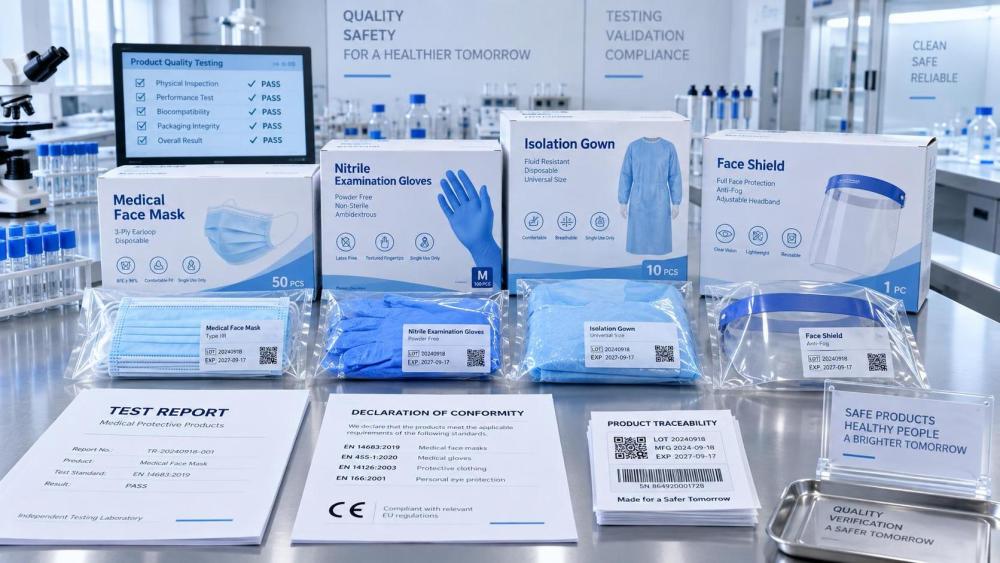
Documents that should be examined together
- A product specification showing model, dimensions, materials, performance claims, packaging configuration, and storage conditions.
- A declaration of conformity or equivalent market document, where applicable, identifying the legal manufacturer and relevant product scope.
- Test reports from a competent laboratory that state the test method, sample identification, results, date, and laboratory identity.
- Quality management evidence relevant to the manufacturer’s scope, recognizing that a quality-system certificate does not replace product testing.
- Label artwork and instructions for use, including warnings, limitations, lot or batch identification, and manufacturer details.
- Sterilization and shelf-life evidence when sterility is claimed, including the stated sterile barrier system and storage instructions.
A useful review method is to make a one-page comparison sheet. Put the supplier’s quotation model code in one column and the model code appearing on each document in another. Then compare material, size, intended use, standard, factory, and packaging. Any unexplained mismatch should stop the item from moving directly into approved stock.
Read test reports beyond the pass statement
Test reports are often presented as proof that a product “passed.” The more important question is: passed which test, using which sample, against what acceptance criterion? A report may be technically authentic yet irrelevant to the item under review. For example, a report for a nonwoven fabric does not necessarily demonstrate finished-mask performance. A glove material report does not replace testing of the finished glove. A gown fabric result may not reflect seam performance, coverage, closures, or the product’s designated critical zones.
Check that the report identifies the finished product or a clearly traceable sample. Confirm that the test method matches the claimed standard and that the reported units make sense for the claimed property. Examine whether the tested size, thickness, material formulation, and construction match the proposed supply. If a report is old, that is not automatically disqualifying, but the manufacturer should be able to explain whether the design, raw materials, production site, and quality controls remain unchanged.
For gloves, pay attention to pinhole or freedom-from-defects testing, dimensions, tensile properties, and material-specific concerns such as natural rubber latex protein claims where relevant. For masks, distinguish filtration performance from fluid resistance and breathability; one favorable result does not establish all three. For gowns, confirm the applicable barrier level and the area to which it applies. For face protection, verify whether the evidence supports splash coverage, impact claims, or both.
Inspect labeling and packaging before accepting stock
Receiving inspection should confirm that the physical goods match the approved evidence. Cartons and individual packaging should carry clear identification appropriate to the product and market: product name, manufacturer or responsible economic operator where required, model or reference, lot or batch number, size, quantity, storage conditions, and expiration date when applicable. Sterile products need unmistakable sterile status and instructions not to use the item if the package is damaged.
Look for practical warning signs. These include labels that identify a different manufacturer from the declaration, inconsistent lot numbers across inner and outer packaging, performance claims that are not mentioned in the supplied reports, poor print quality, altered labels, missing instructions, or a stated expiry without any available shelf-life support. A single defect may have an innocent explanation; several inconsistencies should be treated as a controlled nonconformance.
Packaging also affects PPE safety. Compressed cartons, wet cases, broken sterile barriers, direct sunlight exposure, and storage outside the manufacturer’s conditions can compromise usability even when the original documents were acceptable. Record the condition at receipt, quarantine suspect cartons, and preserve samples and photographs when investigating a concern.
Control the supplier, not only the sample
A pre-shipment sample can be genuine and compliant while later production differs in material, thickness, construction, or packaging. This risk is higher when supply chains involve brokers, trading entities, relabeling arrangements, or rapid product substitutions. Supplier qualification therefore needs to establish who actually manufactures the item, who owns the technical documentation, and who is responsible for complaint handling and corrective action.
Ask direct operational questions: Can the supplier provide lot traceability? Is there a defined process for design or material changes? Will the buyer be notified before a manufacturing site, raw material, packaging component, or performance specification changes? Can the supplier identify the production date and retained sample for a supplied lot? Clear answers supported by documents are more useful than broad assurances about quality.
Where risk and volume justify it, incoming verification can include a documented visual inspection, dimensional checks, packaging checks, and targeted independent testing. The testing plan should be proportionate. It is not necessary to duplicate every type test on every delivery, but critical claims, new suppliers, changed materials, complaint history, and high-risk clinical applications justify closer control.
Separate product approval from use approval
Even compliant PPE can fail in practice if it is used outside its limitations. A respirator requires an appropriate fit process and user instruction. Gloves can lose integrity through incompatible chemicals, prolonged wear, or poor sizing. Gowns may not provide the expected protection if the selected barrier level is below the anticipated exposure. Face shields may leave gaps when paired with other equipment in an unsuitable configuration.
Before release for use, make sure the product instructions are understandable to the users, sizes are available, storage conditions can be maintained, and the chosen item fits the organization’s infection-control and occupational-safety procedures. Compliance documentation establishes a basis for acceptance; it does not replace training, fit assessment where required, or local risk assessment.
Questions that often arise during PPE verification
Is a CE mark or similar marking enough to approve PPE?
No. Marking should be checked against the product, manufacturer, intended use, declaration, labeling, and applicable market requirements. It does not remove the need to verify that the supplied model and claimed protection are appropriate for the clinical task.
Can a supplier’s ISO certificate prove that gloves or masks meet performance standards?
No. A quality management certificate may provide useful evidence about the manufacturer’s system, but it does not prove the performance of a specific finished product. Product-specific testing and labeling review are still needed.
What should happen when a lot does not match the approved documents?
Place the lot under quarantine, document the mismatch, and request a written explanation with corrected evidence. Do not relabel, distribute, or substitute the product until the discrepancy has been resolved through the organization’s controlled approval process.
Have questions about the global trade trends discussed here, or planning your expansion and supply chain strategy? Leave a message below and let the trade experts at MTHH guide you.
We respect your privacy. Your information is strictly confidential.
Related News
- FDA Issues Benefit-Risk Discussion Paper on Robotic Medical DevicesNov 07, 2026Explore the FDA discussion paper on robotic medical devices, its potential benefit-risk implications, and what manufacturers and purchasers should monitor.
- How to select ISO standards for medical device performance evaluationNov 06, 2026Choose medical device performance evaluation ISO standards with confidence. Learn to match claims, test methods, and regulatory requirements to reliable evidence.
- FDA Updates QMSR FAQs and Medical Device Cybersecurity GuidanceNov 06, 2026FDA QMSR FAQs and medical device cybersecurity guidance: Explore potential implications for ISO 13485 alignment, compliance planning and supplier coordination.
- Philips Reaches €288 Million Settlement in US Respiratory Device Recall ProbeNov 05, 2026Philips reaches a €288 million US settlement over its respiratory device recall. Explore the financial impact and implications for manufacturers.