
How to verify electrical safety of ICU equipment for hospitals
Verifying the electrical safety of ICU equipment for hospitals requires more than a pass label on each device. A defensible assessment connects the equipment’s design and intended use with its power supply, patient connections, accessories, inspection results, and service history. It also establishes what happens when a device fails a check.
For an ICU ventilator, monitor, infusion pump, or electrically powered bed, the practical question is not simply whether electricity is present or whether the equipment turns on. It is whether accessible parts, protective connections, and patient connections remain safe under the test conditions specified for that equipment, and whether the complete installation can be used without introducing additional electrical hazards.
Start with the equipment and its intended use
Build the verification plan from an accurate inventory. Record the manufacturer, model, serial number, equipment class, power source, location, and connected accessories. Identify devices that make electrical contact with patients, such as monitors with ECG leads, as well as equipment used near patients without a direct patient connection.
The distinction matters because an applied part, the part of medical electrical equipment intended to contact the patient, may require a different assessment from the enclosure or power cord. Applied parts also have different classifications, commonly identified as Type B, BF, or CF. The classification affects the tests and limits that apply; it should be taken from the equipment labeling and instructions, not inferred from the device category.
Also identify how the equipment is powered. A Class I device relies on protective earth as part of its protection against electric shock. A Class II device uses double or reinforced insulation and does not depend on protective earth in the same way. Battery-powered equipment may still need assessment of its charger, mains connection, and behavior while charging. The appropriate test sequence depends on the actual design and configuration.
Before testing, collect the manufacturer’s instructions for use and service, the applicable hospital procedure, previous results, and information about repairs or modifications. These documents help establish which measurements are meaningful and which test methods could damage sensitive circuits.
Which standards should guide the assessment?
Standards serve different purposes. A manufacturer’s design and type-testing evidence is not a substitute for checks performed after installation or during the equipment’s service life.
- IEC 60601-1 addresses general requirements for the basic safety and essential performance of medical electrical equipment. Particular standards may add or modify requirements for specific equipment types.
- IEC 62353 addresses recurrent testing and testing after repair of medical electrical equipment and medical electrical systems. It provides methods intended for in-service assessment, which are not necessarily interchangeable with the design tests used for product conformity.
- Installation and facility requirements address the electrical environment, including power distribution and protective measures in medical locations. The applicable rules depend on the jurisdiction and the facility’s adopted standards.
Use the edition and national adoption applicable to the organization, together with the manufacturer’s instructions and local requirements. For procurement, request evidence covering the exact model and configuration supplied, including relevant accessories and any applicable particular standards. A certificate or declaration can support acceptance, but it does not show that a cord was undamaged during delivery or that the installed system is connected correctly.
Do not transfer a leakage-current limit from one standard, test method, or device classification to another. The acceptable result depends on what is being measured, the test configuration, and the criteria governing that assessment. The test record should identify those criteria so that the pass or fail decision can be reproduced.
A practical electrical safety verification sequence
Testing should be planned by trained personnel using suitable, maintained test equipment. Coordinate with the clinical team before disconnecting an ICU device: a safety inspection must not interrupt treatment or monitoring without an approved alternative in place. Follow infection-control and equipment-handling procedures, and isolate equipment before opening covers or carrying out work that requires de-energization.
1. Inspect the device and its connections
Begin with a visual inspection. Look for damaged plugs, exposed conductors, loose connectors, cracked housings, signs of overheating, liquid ingress, damaged strain relief, and unauthorized modifications. Check patient cables, sensors, power supplies, and detachable cords for compatibility and condition.
Inspect labels and controls for legibility, and check that required accessories are present. A device can produce acceptable electrical readings while a damaged plug, intermittent connector, or incorrect accessory creates a hazard in use. Visible defects should be assessed and corrected before the device is returned to service.
2. Check protective earth where applicable
For equipment that relies on protective earth, measure the continuity of the protective connection using the method and test points appropriate to the device. The goal is to establish that accessible conductive parts intended to be earthed have a reliable path back to the protective earth connection.
Do not assume every metal part is an appropriate test point. Some conductive parts may not be intended to be connected to protective earth, and some connections may be inaccessible without disassembly. The manufacturer’s instructions and the selected procedure determine where and how to test. Investigate a high or unstable reading for causes such as a damaged cord, loose connection, corrosion, or an unsuitable measurement point.
3. Measure leakage currents using the selected method
Leakage current is a small current that can flow through insulation or unintended paths. Medical equipment is designed to control it, but damaged insulation, contamination, incorrect connections, or component failure can change the result.
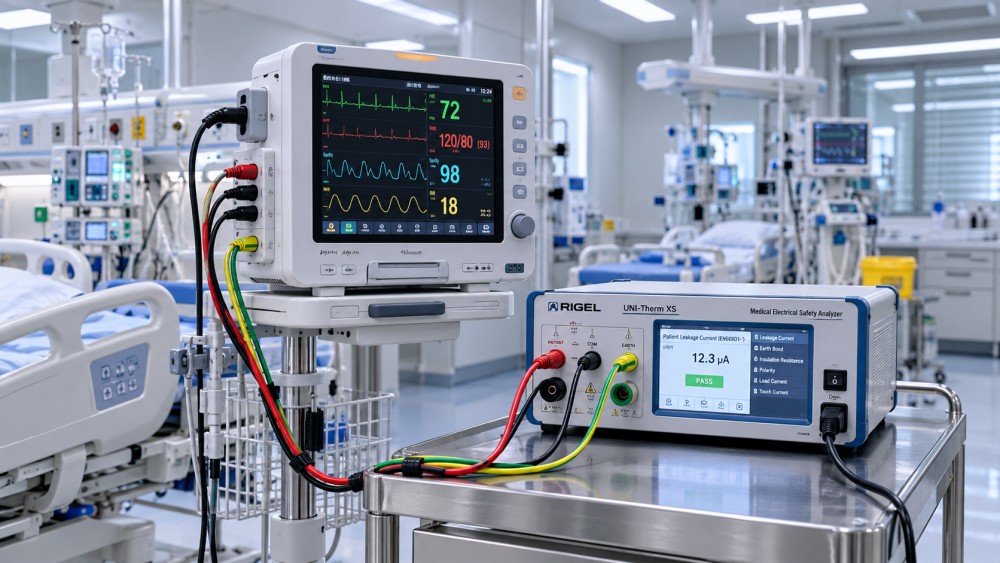
Depending on the device and the chosen procedure, the assessment may include equipment leakage current and leakage associated with applied parts. An electrical safety analyzer can support these measurements, but its displayed result is only useful when the operator has selected the correct test, connected the leads properly, and applied the right acceptance criteria.
Direct, differential, and alternative leakage methods do not necessarily produce equivalent results. Record the method used rather than treating all readings as interchangeable. Pay particular attention to accessories and external connections: disconnecting them may be necessary for a defined test, but doing so can also change what the measurement represents. Follow the prescribed configuration and document any deviations.
4. Assess insulation only when the method is suitable
Insulation resistance testing can help reveal deterioration, but it is not a universal test to apply indiscriminately to every electronic device. The test voltage and connection points must be appropriate for the equipment. A method intended for ordinary electrical appliances may be unsuitable for medical equipment with sensitive electronics or patient circuits.
Where the manufacturer or the applicable procedure restricts a test, use the specified alternative assessment. Never improvise by applying a higher test voltage or probing internal components simply to obtain a reading.
5. Restore the operating configuration and check function
After electrical measurements, reconnect the equipment as intended and perform the functional checks required by the manufacturer and hospital procedure. For example, a monitor may need checks of its patient connections and alarms; a ventilator may require checks relevant to its delivery and alarm functions.
Electrical safety and clinical function are related but separate decisions. A device that passes leakage testing can still have an alarm, battery, sensor, or performance fault. Conversely, a device that appears to function normally may have an unsafe protective earth connection. Both findings belong in the release decision.
Assess the ICU installation, not just individual devices
An ICU bed space often contains several connected devices, accessories, network connections, and a shared power arrangement. The complete configuration can create risks that are not visible when equipment is tested alone. For example, connecting devices through signal cables can create additional electrical paths, while an unsuitable power strip can introduce mechanical damage, overload, or an unreliable earth connection.
Review the configuration as a medical electrical system where the applicable requirements and manufacturer instructions call for it. Document which devices are connected, how they receive power, and which accessories or interfaces are part of the arrangement. Do not assume that individually compliant devices automatically form a compliant system when connected together.
The facility assessment should also address the condition and suitability of sockets, protective earthing, and power continuity arrangements. Coordinate this work with the personnel responsible for the hospital electrical installation. Equipment testing cannot establish that a wall outlet, circuit, or emergency power arrangement is suitable for its intended use.
A practical check at a bed space should include cable routing and the risk of cords being trapped by bed movement, damaged during cleaning, or disconnected during transport. These observations do not replace electrical measurements, but they can reveal how a safe device may become unsafe in routine use.
Set inspection intervals around risk and change
A fixed schedule is useful only if it reflects the equipment and its use. Establish intervals through the hospital’s risk-based maintenance program, taking account of manufacturer recommendations, applicable requirements, device condition, previous failures, and the consequences of loss of function.
Electrical safety verification is particularly relevant at acceptance, after installation when required, following repairs or modifications that could affect electrical safety, and during recurrent inspection. Damage, liquid exposure, a reported electric shock, or repeated unexplained faults should also trigger assessment under the hospital’s incident and maintenance procedures.
Not every accessory replacement requires the same full test sequence. The decision should reflect what was changed, whether protective or patient-connected circuits were affected, and what the manufacturer’s service instructions require. Record the reasoning when the scope differs from the routine procedure.
What to record and how to handle a failure
A useful record allows another qualified person to understand what was tested and why it passed. Alongside equipment identification and location, include:
- The reason for testing, such as acceptance, scheduled inspection, or repair.
- The applicable procedure, test method, acceptance criteria, and relevant equipment classification.
- The configuration tested, including significant accessories and connections.
- Visual inspection findings, measured values and units, and functional check results.
- The test instrument identification, its calibration status, the date, and the person performing the work.
- Any defects, corrective action, retest results, and the authorization to return the device to service.
Measured values are more useful than a pass label alone. A series of results obtained using the same method can help identify a developing problem, although a change in readings must be interpreted in light of test conditions, instrument differences, and configuration.
If a result fails its applicable limit, or the device presents an immediate electrical hazard, remove it from service under the hospital’s process, identify it clearly, and arrange an appropriate replacement for patient care. Record the fault, investigate and repair it, then repeat the relevant electrical and functional checks before release. A failed result should not be overridden simply because the device still powers on.
For incoming equipment, the most useful release decision combines supplier documentation, inspection of the delivered configuration, appropriate electrical testing, functional verification, and confirmation that the ICU installation supports the intended use. That chain of evidence makes the safety decision traceable throughout the device’s working life.
Have questions about the global trade trends discussed here, or planning your expansion and supply chain strategy? Leave a message below and let the trade experts at MTHH guide you.
We respect your privacy. Your information is strictly confidential.
Related News
- Hong Kong Outlines Medical Device Legislation and Plans for Statutory RegulatorNov 14, 2026Hong Kong medical device legislation could reshape regulatory oversight. Explore the proposed regulator and what businesses should monitor.
- AAMI Issues TIR115 Guidance on Public Cloud Use in Medical DevicesNov 13, 2026AAMI TIR115:2026 guides public cloud use in medical devices. Explore its focus on risk management, supplier assessment and device boundaries.
- How are critical care devices regulated in the United States?Nov 12, 2026Critical care devices face FDA requirements based on intended use and risk. Explore classifications, marketing pathways, and practical compliance checks.
- Hong Kong Drafts Medical Device Bill to Establish Statutory OversightNov 12, 2026Hong Kong's Medical Devices Bill could introduce risk-based statutory oversight. Discover what the proposed framework may mean for suppliers.