
How to Investigate a Failed Process Validation Run Without Delaying Release
A failed validation run can threaten release timing, patient safety, and audit readiness, but it does not automatically prove that the manufacturing process is unacceptable.
For operators supporting process validation for medical devices, the immediate priority is to preserve facts, control affected product, and avoid conclusions based on incomplete evidence.
The practical question is not simply, “Why did the run fail?” It is whether the result indicates a true process failure, an execution error, or unreliable data.
A disciplined investigation can support a timely, compliant disposition when the evidence shows that product quality, validated state, and regulatory commitments remain protected.
This guide focuses on the actions operators can take during and after a failed process validation run, including documentation, evidence collection, escalation, and corrective-action support.
Start With Containment, Not a Quick Explanation
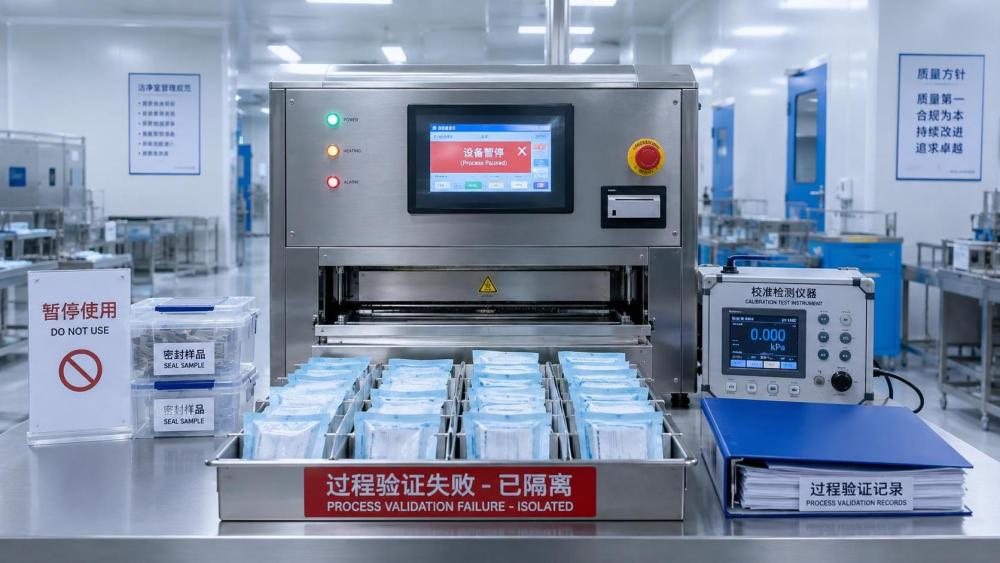
When a validation acceptance criterion is missed, stop the affected activity according to the approved procedure and notify the designated quality and manufacturing representatives immediately.
Do not adjust settings, discard samples, restart the equipment, or repeat the test before documenting the observed condition and receiving authorized direction.
Early containment protects both the product and the investigation. It prevents an isolated event from becoming a wider quality issue through uncontrolled continued processing.
Clearly identify all affected material, including in-process units, samples, components, labels, records, and electronic files associated with the validation run.
Use the applicable hold status, quarantine location, or electronic inventory control required by the site quality system. Physical segregation must match system records.
Release should never continue merely because the failure appears minor. However, placing material on hold does not mean the batch will necessarily be rejected.
The purpose of the initial hold is to create time for an evidence-based assessment. It separates release pressure from the technical investigation.
Operators should record the exact time of discovery, process step, equipment status, alarm messages, observed parameters, and names of personnel involved.
Contemporaneous notes are more valuable than reconstructed explanations. They help investigators distinguish what was observed from what was later inferred.
If the issue involves patient-contacting components, sterilization, sealing, dosage, software-controlled settings, or critical measurements, escalate with heightened urgency.
These areas often have direct implications for safety, essential performance, sterility assurance, or device traceability, requiring prompt quality review before any disposition decision.
Confirm What Actually Failed Before Calling It a Process Failure
A failed result can originate from the process, the measurement method, the equipment, the sample, the record, or a deviation in execution.
Before assigning root cause, verify the failed acceptance criterion against the approved validation protocol, current work instruction, specification, and validated sampling plan.
Confirm that the correct product configuration, lot, tooling, software version, test method, and acceptance limits were used during the run.
Small administrative mismatches can produce apparently failed results. Examples include an outdated test worksheet, incorrect revision, wrong sample identification, or transposed data.
These findings still require formal investigation, but they may not demonstrate that the manufacturing process cannot repeatedly meet its intended requirements.
Review raw data rather than relying only on summary reports. Check instrument printouts, audit trails, calibration status, photographs, environmental records, and operator logbooks.
For electronic systems, preserve audit-trail information before troubleshooting activities overwrite relevant data or create confusion about the original system state.
Compare the run against previous engineering, qualification, and validation evidence. A single unusual point may have a different meaning than a recurring adverse trend.
Ask whether the result was truly outside the approved limit, whether the limit was correctly applied, and whether the test result is scientifically valid.
An out-of-specification measurement is not automatically proof of product nonconformance if the test system itself was not functioning as intended.
At the same time, operators should not assume a measurement problem simply because the production result is inconvenient. Evidence must support every conclusion.
Build a Clear Timeline of the Validation Run
A precise timeline is one of the fastest ways to identify whether a failed validation run resulted from a localized event or a systemic process issue.
Begin with pre-run activities: material release, equipment setup, line clearance, calibration verification, training status, environmental preparation, and document issuance.
Then capture each critical process step in sequence, including actual settings, start and stop times, intervention points, alarms, pauses, adjustments, and sample collection.
Identify exactly when the result first became abnormal. The point of divergence often narrows the investigation more effectively than a broad review of every operation.
For example, a sealing failure after a documented pressure drop may point toward equipment performance, while scattered failures may suggest material variation or handling issues.
Record who performed each operation and whether a handoff occurred. Personnel changes can reveal communication gaps, unclear instructions, or missed verification activities.
Review environmental conditions where relevant. Temperature, humidity, particulate controls, differential pressure, compressed air, water quality, and power stability may affect critical outputs.
For medical device manufacturing, the timeline should also identify all product potentially impacted before and after the failed point, including associated lots and rework material.
This supports a defensible product impact assessment and prevents investigators from limiting the review to only the samples that produced the failed result.
Do not rely on memory for details such as valve positions, machine messages, or temporary interventions. Attach objective records wherever possible.
A well-constructed timeline also helps quality reviewers decide whether additional sampling, retesting, equipment checks, or expanded batch review is necessary.
Separate Operator Error From Process Weakness
Operators are often concerned that a failed run will automatically be classified as human error. A credible investigation must examine the system, not only the individual.
Determine whether the operator followed the approved instruction exactly, including setup checks, parameter entry, verification steps, sampling technique, and documentation requirements.
If an instruction was followed but the outcome still failed, the procedure, equipment design, training approach, or process controls may be inadequate.
When an operator did not follow an instruction, investigators should still ask why. The underlying cause may be unclear wording, poor ergonomics, insufficient training, or conflicting documents.
A genuine execution error should be supported by objective evidence, such as a missing check, recorded incorrect setting, camera evidence, or direct observation.
Avoid vague findings such as “operator mistake” or “lack of attention.” These statements do not explain what allowed the error or how recurrence will be prevented.
For process validation for medical devices, human factors matter especially when critical steps depend on manual assembly, visual inspection, labeling, packaging, or test interpretation.
Assess whether the task can be performed consistently by trained operators under normal production conditions, rather than only by highly experienced validation personnel.
Review training records, but do not treat completed training as proof of competence. Confirm that the training covered the exact equipment, product version, and process revision.
Where appropriate, observe a controlled repeat setup or simulation. This can reveal practical difficulties that were not apparent from records alone.
The objective is to establish whether the failure was isolated and correctable or whether the process lacks sufficient robustness for routine manufacturing.
Assess Product Impact Before Discussing Release
Release decisions should be based on product impact, not schedule pressure. The key question is whether affected devices can still be shown to meet approved requirements.
Start by identifying the critical quality attributes connected to the failed result. These may include sterility, package integrity, dimensions, functional performance, cleanliness, or labeling accuracy.
Then determine whether the failure directly affects those attributes or whether it reflects a process indicator with no demonstrated effect on finished-device quality.
This distinction is important, but it must be scientifically justified. A noncritical parameter may still indicate loss of control if it affects a validated process window.
Review the device risk management file, process failure mode analysis, validation rationale, and historical complaint or nonconformance data when assessing potential harm.
For example, a minor documentation discrepancy may be manageable through record correction, while a sterilization-cycle deviation may require extensive product evaluation and possible rejection.
Consider the scope of affected material carefully. Determine whether the event occurred before, during, or after production of the units proposed for release.
Evaluate whether traceability permits a narrow impact boundary. Inadequate traceability may expand the investigation because unaffected units cannot be confidently separated.
Additional inspection or testing can sometimes support release, but only when it is scientifically appropriate and approved through the quality system.
Testing alone cannot repair an inadequately validated process. It should not be used to bypass the need to understand a critical process deviation.
The final disposition should state clearly why product is acceptable, unacceptable, or pending further action, with evidence linked to each conclusion.
Use Retesting and Repeat Runs Carefully
Retesting can be useful, but it is one of the most misunderstood parts of a failed validation investigation. A passing repeat does not erase the original failure.
Before repeating a test, document why the original result may be invalid or why a repeat is necessary to gather additional information.
Define the repeat conditions in advance. State which samples, equipment, personnel, method settings, and acceptance criteria will be used before performing the activity.
Unplanned repeat testing creates a risk of testing into compliance. Regulators and quality auditors may question results when failed data are replaced without clear scientific justification.
If a confirmed execution error invalidated the run, a repeat validation activity may be appropriate after correcting the error and documenting the correction.
If the process itself appears unstable, repeating the run without changing anything may provide useful evidence, but it may also confirm that the process lacks reproducibility.
When corrective actions are implemented before a repeat run, assess whether the change is minor, requires protocol amendment, or triggers partial or full revalidation.
Operators should follow the approved protocol and avoid informal “trial runs” using production-intended material unless explicitly authorized and documented.
Engineering trials can support investigation, but they must be clearly segregated from formal validation evidence and from material intended for commercial release.
The repeat-run report should reference the original event, explain the investigation outcome, and show how the new evidence supports the final validation conclusion.
Implement Corrective Actions That Support Timely Release
The fastest compliant investigation is not the shortest report. It is the investigation that identifies the right evidence early and implements proportionate corrective action.
Corrective actions should directly address the established root cause. Rewriting a procedure is not sufficient if the actual cause was uncalibrated equipment or unsuitable material.
For an isolated setup error, effective action may include documented retraining, an independent setup verification, and a revised checklist with clear critical parameters.
For equipment-related causes, actions may include repair, calibration, maintenance review, alarm verification, software assessment, and evaluation of other lots processed on the same equipment.
For material causes, review supplier records, incoming inspection data, storage conditions, component specifications, and whether other material lots show similar behavior.
For documentation causes, correct the controlled document system, assess the use of obsolete revisions, and verify that all affected personnel receive the current instruction.
Every action should have an owner, due date, effectiveness check, and documented link to the investigation. Open actions should be visible before product release is approved.
Not every corrective action must be completed before release, but any open action must not leave unresolved risk to product quality, patient safety, or regulatory compliance.
Quality assurance should document the release rationale, including the investigation status, product impact conclusion, additional controls, and justification for any remaining actions.
Document the Investigation So It Withstands Review
A strong investigation record allows reviewers to understand the event without relying on verbal explanations. It should tell a complete, chronological, evidence-based story.
Include the original failure, affected product scope, immediate containment, data review, timeline, root-cause analysis, impact assessment, corrective actions, and release decision.
Use precise language. State what happened, what records prove it, what was considered, and why alternative causes were ruled out.
Do not state that a process is “validated” simply because a repeat run passed. Explain how the full body of evidence supports process consistency and product conformity.
For medical device operations, connect conclusions to approved specifications, validation protocol requirements, risk controls, and applicable quality-system procedures.
Ensure all attachments are traceable and legible. This includes raw data, instrument outputs, calibration certificates, photographs, training records, environmental logs, and deviation forms.
Before closure, perform an independent review for gaps. Check whether the investigation answers the original question and whether the proposed release decision follows logically.
Good documentation protects operators as well as the organization. It shows that actions were controlled, decisions were authorized, and patient safety remained central.
Conclusion: Release Can Be Timely Without Being Rushed
A failed validation run should trigger disciplined action, not panic. The correct response is to contain the issue, preserve evidence, determine the true cause, and assess product impact.
For teams performing process validation for medical devices, timely release is possible when the investigation proves that the event was isolated, understood, controlled, and appropriately documented.
Operators contribute most by recording facts accurately, protecting affected material, following escalation procedures, and avoiding undocumented adjustments or assumptions during the investigation.
When evidence demonstrates that product requirements remain met and quality-system controls are effective, release decisions can be both efficient and defensible.