
When a device is introduced on a ward, a signed attendance sheet may show that staff attended a demonstration, but it does not establish which tasks they can perform or whether their skills were assessed. During an internal review or after a safety event, that gap can make it difficult to determine who was authorized to use the equipment and what instruction they received.
Document medical equipment training compliance by linking each person to a defined device and role, the instruction provided, an appropriate competency assessment, the outcome, and any required follow-up. Keep those records retrievable and current, while checking the organization’s policies, manufacturer instructions, accreditation obligations, and applicable local requirements before deciding what evidence is mandatory.
Start with the tasks that need evidence
A training record is useful only if it corresponds to the work a person is expected to perform. A clinician using an infusion pump, a technician maintaining it, and a staff member responsible for cleaning it may need different instruction and different assessments. A single course titled “infusion pump training” can obscure those differences.
Create a training matrix before collecting signatures. List the device or device family, the relevant roles, permitted tasks, required learning, assessment method, and the person or function responsible for maintaining the record. Include temporary and agency personnel where they perform covered tasks. Identify who may work independently and who must remain supervised until assessment is complete.
Use risk and task complexity to determine the level of evidence. Basic orientation to a low-risk accessory may need a simpler record than setup and alarm response for a ventilator. The matrix should still follow local policy and any applicable requirements; a risk-based approach is a way to organize evidence, not permission to disregard a prescribed training obligation.
Device families can be grouped when operation and safety controls are sufficiently similar, but document the basis for grouping. Differences in software, interfaces, accessories, alarm behavior, or intended use may require model-specific instruction. A record that names only “patient monitor” may be inadequate when staff use several materially different systems.
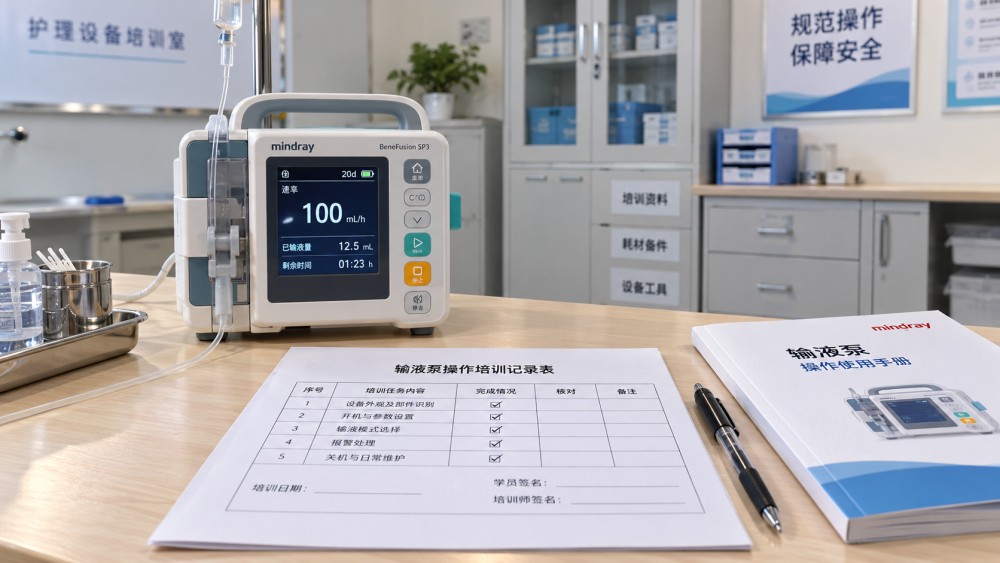
Build a record that can be traced and checked
A complete record should allow a reviewer to reconstruct the training without relying on the trainer’s memory. The exact form can be paper-based or electronic, provided it is legible, controlled, and retrievable. Capture the following information for each relevant training event or competency decision:
- Person and role: the learner’s name, unique staff identifier where used, department, and role or scope of permitted work.
- Equipment: manufacturer, model or device family, and relevant software version, configuration, or accessories. An asset identifier may be useful when training applies to a specific installation.
- Training content: the tasks and safety topics covered, with a reference to the controlled lesson plan, procedure, or manufacturer instructions and its version.
- Delivery: the date, method, trainer’s identity and qualifications or authorization, and whether the session was initial, refresher, or change-related training.
- Competency evidence: the assessment method, criteria, result, assessor, date, and any limitations or supervision requirements.
- Follow-up: the next review or refresher date when applicable, outstanding actions, reassessment results, and authorization status.
Distinguish the date of instruction from the date competency was demonstrated. A learner may attend a session but require practice before being assessed. Recording both dates prevents the organization from treating attendance as immediate clearance for independent work.
Connect supporting documents without copying everything
The individual record does not need to reproduce the entire training package. It can reference a controlled syllabus and assessment checklist, as long as the referenced version remains available for the required retention period. For example, a record might identify the device model, course identifier, syllabus revision, and checklist revision. The linked documents should show what was taught and how performance was judged at the time.
Where a supplier delivers training, obtain enough detail to make the record usable: participant identities, device scope, topics, date, instructor, and any assessment results. A supplier’s completion certificate may support the file, but it should not automatically be treated as proof that the person is competent in the organization’s own workflow. Document any local assessment or authorization separately.
Record competency, not just participation
Choose an assessment that matches the task and its risk. A knowledge test can help establish understanding of warnings or operating principles, but it may not show that a person can set up equipment, respond to an alarm, or recognize an unsafe condition. For hands-on tasks, direct observation using a defined checklist may provide stronger evidence. Simulation can be appropriate when testing on a patient or live clinical process would be unsafe.
The checklist should describe observable actions and the standard for an acceptable result. For an infusion pump, relevant tasks might include identifying the correct device and accessories, completing pre-use checks, setting the prescribed parameters, responding to a simulated alarm, and knowing when to stop and escalate. The exact steps must match the device instructions and local procedures; the example is not a substitute for either.
Record the outcome as more than a signature. The assessor should indicate whether the learner met the criteria, which tasks were not demonstrated or not passed, and any restrictions. A failed assessment is not a documentation failure: it is evidence that a gap was identified. Record remediation, the reassessment date and result, and who authorized the learner to resume the relevant tasks. Do not overwrite the original outcome.
Where staff train others, define how trainers and assessors are selected and how their own competence is documented. Attendance at a supplier session alone may not establish that someone can assess colleagues against local criteria. If one person both teaches and assesses, use documented criteria and any independence controls required by policy.
Turn training events into a controlled workflow
- Assign requirements before access. Match each person’s role and location to the training matrix. Record the required modules and assessment before the person is expected to use or maintain the device independently.
- Deliver and capture instruction. Use the current approved materials. Record the session and learner attendance, including any content omitted or delivered later.
- Assess the required tasks. Apply the approved criteria, retain the completed assessment or a traceable electronic equivalent, and document the assessor’s decision.
- Resolve gaps. Assign remedial instruction and reassessment where needed. Until requirements are met, apply the organization’s controls for supervision, restricted duties, or removal of access.
- Confirm authorization and review dates. Make the status visible to the person responsible for staffing or equipment access, and enter any required refresher or review date.
Assign ownership at each handoff. Education staff may administer courses, clinical leads may determine role-specific competence, and clinical engineering may provide technical instruction. Quality oversight should verify that responsibilities are defined and that incomplete records are followed up; it need not mean one team performs every assessment.
A new device installation is also a useful point to reconcile records with the deployment plan. Check whether all relevant shifts and locations are covered, whether trained staff can safely support those awaiting assessment, and whether any configuration-specific instructions have been included. Record exceptions and the person responsible for closing them rather than assuming the supplier’s on-site session covered everyone.
Keep records current when equipment or work changes
Training can become outdated even when the original record is complete. Review the matrix and affected staff records when a model is replaced, software changes the user interface, accessories change, a procedure is revised, or a safety notice alters operating instructions. A change assessment should identify what changed, which roles are affected, whether instruction or reassessment is needed, and when the action must be completed.
Not every update requires a full repeat of initial training. A documented review may determine that a targeted briefing, acknowledgement of revised instructions, or a focused practical assessment is sufficient. Record the rationale and approval under the organization’s change-control process. For significant changes to safety-critical tasks, a practical reassessment may be more appropriate than an email acknowledgement.
Refresher intervals should come from applicable requirements and organizational policy, informed by device risk, frequency of use, observed performance, and manufacturer guidance. Avoid presenting one interval as universal. Some organizations may also trigger review after extended absence, transfer to a new role, an incident, or evidence that a procedure is not being followed.
When an event suggests a training issue, preserve the distinction between a possible skill gap and the eventual finding. Review the relevant training version and competency record alongside device condition, instructions, staffing, and workflow. Document any resulting training action without assuming that retraining alone addresses every cause.
Make records reliable enough for review
Access controls should protect staff information while allowing authorized reviewers to find evidence promptly. Define who may create, approve, amend, and view records. Electronic systems should retain an audit trail where required or appropriate; paper corrections should remain legible, attributable, and dated under the organization’s document-control rules. Do not silently replace an earlier assessment with a later pass.
Set retention and disposal periods according to applicable law, accreditation obligations, contracts, and organizational policy. Consider whether supporting course materials and assessment criteria must be retained alongside individual records. A database entry that points to a deleted checklist may prove that an assessment occurred but not what it covered.
Periodically test retrieval using a sample drawn from the training matrix. Start with a role and device, identify the people expected to perform the task, then trace their training, assessment, and authorization. Reverse the check by selecting a record and confirming that its referenced materials and assessor details are available. Investigate missing evidence, overdue reviews, and mismatches between actual duties and recorded scope.
If evidence cannot be located, do not backdate a form or reconstruct an assessment as though it had been observed. Mark the record as incomplete, establish the person’s current status under local policy, and arrange training or assessment where necessary. Document the corrective action and examine whether the same gap affects other staff or devices.