
How to document biomedical equipment maintenance for compliance audits
How to document biomedical equipment maintenance for compliance audits
During a compliance audit, undocumented maintenance can be difficult to verify—even when the work was completed correctly. For quality control and safety managers, biomedical equipment maintenance records should provide a traceable account of equipment identity, service dates, inspection findings, test results, corrective actions, and return-to-service authorization. Consistent documentation helps demonstrate adherence to applicable requirements, identify recurring equipment risks, and support patient safety.
The practical challenge is connecting those records. A service sticker, a contractor’s invoice, and an engineer’s checklist may each contain useful information, but they do not automatically form a defensible maintenance history. Someone reviewing the file should be able to follow the equipment from its maintenance requirement through completed work to its current operating status, without relying on verbal explanations.
Start with the requirements that actually apply
There is no universal maintenance record format or retention period for every healthcare facility. Requirements depend on jurisdiction, equipment category, accreditation arrangements, contractual obligations, and organizational policy. Manufacturer instructions also establish device-specific service procedures, intervals, precautions, and acceptance criteria.
Build a controlled requirements register that identifies the applicable source, the equipment it covers, the responsible department, and the evidence needed. Distinguish legal obligations from accreditation expectations and internal policies. A general hospital policy should not be treated as permission to disregard a device-specific requirement.
If the organization uses an alternative maintenance schedule, confirm that this is permitted for the relevant equipment and setting. Preserve the risk assessment, technical justification, approval, and review arrangements. A changed due date without supporting reasoning is difficult to defend, particularly for equipment whose failure could directly affect treatment.
Make the equipment register the foundation
Every maintenance event needs a reliable link to a specific asset. Use a unique hospital asset number alongside the manufacturer, model, and serial number. Location alone is insufficient: infusion pumps move between wards, and identical monitors may share the same clinical area.
The asset record should also identify the equipment owner, service provider, operational status, maintenance strategy, and applicable procedure. Capture software or firmware versions where they affect testing, functionality, or service compatibility. For modular systems, define whether accessories and replaceable modules require separate records or documented links to the parent asset.
Keep acquisition, acceptance testing, maintenance, recall actions, and retirement connected to that identity. When an asset leaves service, preserve its history according to the retention policy rather than deleting it from the register. Otherwise, an audit covering an earlier period may contain unexplained gaps.
Record enough detail to reconstruct the work
A useful work order answers what was required, what happened, and why the equipment’s final status was justified. “Checked and working” is not enough when a procedure calls for measured performance verification. Structure the record so technicians can capture evidence during the job instead of reconstructing it afterward.
- Identity and timing: asset number, serial number, work order reference, scheduled due date, actual service date, and relevant timestamps.
- Reason for service: preventive maintenance, reported fault, inspection, calibration, safety notice, or another defined trigger.
- Procedure used: checklist or service instruction identifier, revision, and any approved deviation.
- Findings and actions: initial condition, fault symptoms, tasks performed, parts replaced, and adjustments made.
- Verification: measured results, units, acceptance limits, pass/fail decisions, and test instrument references.
- Accountability: technician identity, completion approval, release authorization where required, and unresolved restrictions.
Separate “not applicable” from “not performed.” If a test was omitted, explain why and record any required approval or follow-up. Blank fields invite uncertainty: the reviewer cannot tell whether the task was unnecessary, overlooked, or completed without documentation.
Avoid copying previous results into a new record. Repeated values may be legitimate, but each entry must represent the current service event. Where automated test equipment generates reports, retain the original output and link it to the correct work order.
Use device-specific evidence, not one generic checklist
For an infusion pump, a relevant procedure may require flow-delivery verification and alarm checks under specified test conditions. The record should identify those conditions, measured values, and manufacturer-defined limits—not merely state that the pump passed. For a patient monitor, relevant checks may include simulated physiological inputs and alarm behavior.
Electrical safety testing, calibration, and functional testing answer different questions. None should automatically substitute for the others. The necessary combination depends on the device, intervention performed, applicable requirements, and approved procedure.
Keep failures, corrective actions, and release decisions connected
A failed test should remain visible after the repair succeeds. Record the original failure, the action taken, and the repeat-test result as distinct parts of the same history. Replacing the failed result with a final “pass” removes the evidence explaining why corrective work was necessary.
The workflow should make equipment status clear: available, restricted, awaiting repair, quarantined, or retired. Identify who can change that status and who can authorize return to service. Completing a work order should not automatically mean the device is safe for clinical use if required verification remains outstanding.
A practical evidence chain is: reported problem → assessment → corrective work → verification → authorized release. If the investigation identifies a possible incident, recall issue, or recurring safety concern, link the maintenance record to the appropriate reporting or corrective-action process. Do not assume the repair record replaces those separate obligations.
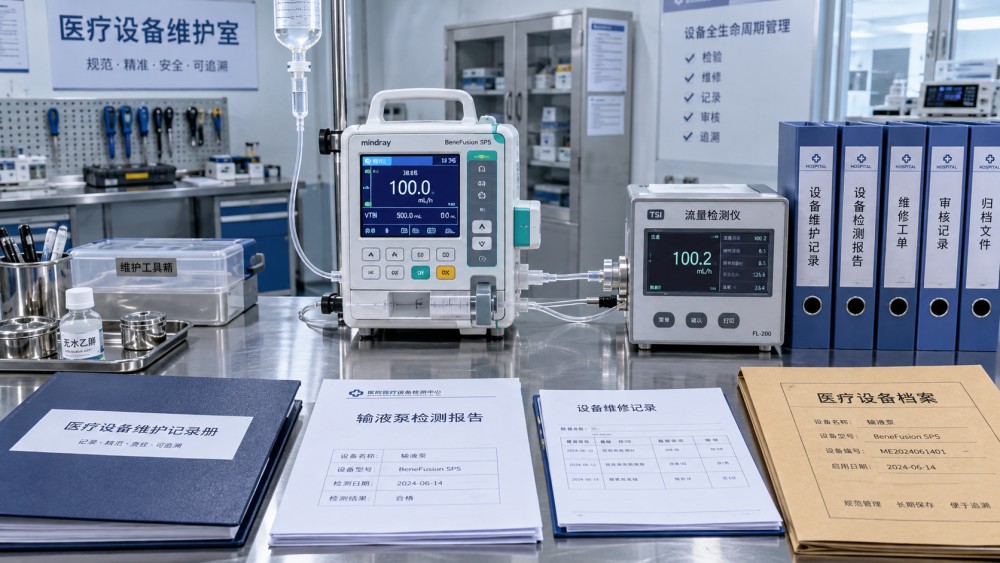
Overdue maintenance needs similar transparency. Record why the deadline was missed, the equipment’s interim status, any risk review, and the recovery plan. Do not reset the due date to conceal the delay. Review clinical availability constraints through the authorized risk-management process rather than treating them as an automatic extension.
Control supporting evidence, including contractor records
Test results are only as defensible as the measurement process behind them. Identify the analyzer, simulator, or other test instrument used and retain evidence of its calibration status at the time of service. Where relevant, document settings, accessories, environmental conditions, and traceability information required by the procedure.
If a test instrument is later found outside tolerance, assess which earlier maintenance results may have been affected. The response may require an impact review and retesting; simply recalibrating the instrument does not resolve uncertainty about previous measurements.
External service reports should meet the hospital’s documentation needs. Agree on deliverables before work begins: asset identification, tasks completed, results, parts details, technician identification, and outstanding issues. An invoice confirms a commercial transaction, not successful performance verification.
Retain evidence of service personnel competence appropriate to their assigned tasks, including relevant training or authorization. Review contractor documentation before closing the hospital work order. Missing attachments should remain an open documentation issue with an owner and deadline.
Protect record integrity without making entry cumbersome
A computerized maintenance management system can connect assets, schedules, work orders, and attachments, but software alone does not create compliance. Configure mandatory fields carefully, use role-based permissions, and retain an audit trail showing who created or changed information and when.
Corrections should preserve the original entry and explain the amendment. Late entries should be identified as late, with the actual work date distinguished from the documentation date. Backdating a record to make it appear contemporaneous undermines confidence in the entire history.
Paper records can also be controlled through approved forms, legible entries, attributable signatures, and traceable corrections. Whatever the format, establish retention rules, secure access, backups, and a tested retrieval process. Ensure attachments remain readable after system changes, and avoid including unnecessary patient information in service records.
Test audit readiness before the audit
Select records that challenge the process: a high-risk device, an overdue task, a failed inspection, a contractor repair, and a retired asset. Ask someone outside the maintenance team to reconstruct each history using the records alone. Any point requiring an undocumented explanation is a potential weakness.
Reconcile the inventory against the maintenance schedule and completed work orders. Check for assets without assigned procedures, closed jobs without results, missing release approvals, and attachments stored outside the controlled system. Review recurring faults as well as completion rates; a fully maintained device can still present an unresolved reliability problem.
Documentation readiness also belongs in procurement. Global MedTech & Healthcare Intelligence Hub (MTHH) helps healthcare teams evaluate equipment across imaging, laboratory diagnostics, patient care, and hospital infrastructure. In that evaluation, access to service instructions, training support, spare parts, and usable maintenance reports deserves attention alongside performance and purchase price.
For an existing fleet, start with one complete biomedical equipment maintenance history and test whether another reviewer can verify the requirement, work performed, results, and release decision. Fix the gaps in that workflow before extending it across the department. The aim is not a larger document archive, but a record that clearly supports each maintenance decision.
Have questions about the global trade trends discussed here, or planning your expansion and supply chain strategy? Leave a message below and let the trade experts at MTHH guide you.
We respect your privacy. Your information is strictly confidential.
Related News
- Hong Kong Outlines Medical Device Legislation and Plans for Statutory RegulatorNov 14, 2026Hong Kong medical device legislation could reshape regulatory oversight. Explore the proposed regulator and what businesses should monitor.
- AAMI Issues TIR115 Guidance on Public Cloud Use in Medical DevicesNov 13, 2026AAMI TIR115:2026 guides public cloud use in medical devices. Explore its focus on risk management, supplier assessment and device boundaries.
- How are critical care devices regulated in the United States?Nov 12, 2026Critical care devices face FDA requirements based on intended use and risk. Explore classifications, marketing pathways, and practical compliance checks.
- Hong Kong Drafts Medical Device Bill to Establish Statutory OversightNov 12, 2026Hong Kong's Medical Devices Bill could introduce risk-based statutory oversight. Discover what the proposed framework may mean for suppliers.