
How to check whether medical gas systems meet NFPA 99 requirements
Checking whether a medical gas installation meets NFPA 99 is rarely a one-document exercise. A file may show that the system was installed by a qualified contractor, pressure-tested, and signed off at handover. That still does not answer the question a quality or safety manager really needs answered: is the system compliant in the way it is actually built, identified, monitored, maintained, and used?
NFPA 99 covers a lot of ground because medical gas systems are not just utilities. They directly support patient care in operating rooms, ICUs, emergency departments, recovery areas, and inpatient wards. Oxygen, medical air, vacuum, nitrous oxide, and instrument air each carry different risks, but the common failure modes are familiar: wrong gas, cross-connection, inadequate alarm response, poor source redundancy, undocumented modifications, or maintenance gaps that only become visible during a fault.
In practice, the most reliable way to assess medical gas systems NFPA 99 compliance is to review the system in layers: source equipment, piping distribution, labeling, alarms, terminal units, testing records, and maintenance documentation. That is also how many experienced clinical engineering teams approach it when they need more than a box-ticking audit.
Start with the system category and scope, not the equipment room
Before checking components, confirm what parts of the installation are subject to the applicable risk category and project scope. NFPA 99 uses a risk-based framework. In healthcare facilities, different spaces may require different levels of reliability depending on whether system failure is likely to cause major injury, minor injury, or mainly operational disruption. That matters because the expected safeguards, redundancy, and documentation are tied to the category of use.
This is where reviews often go slightly wrong. Teams inspect the bulk oxygen manifold or the vacuum pumps in detail, but do not verify whether later expansion areas, renovated treatment rooms, or temporary care spaces were brought into the same compliance process. If the pipe network has been extended over time, one weak section can undermine an otherwise well-documented system.
For hospital planners and procurement teams, this broader view is important. Platforms such as MTHH are useful here not because they replace the code, but because they help connect infrastructure decisions with downstream operational realities: installation conditions, maintenance burden, service readiness, and documentation quality all affect whether a system remains compliant after commissioning.
Verify the source equipment can support normal use and failure conditions
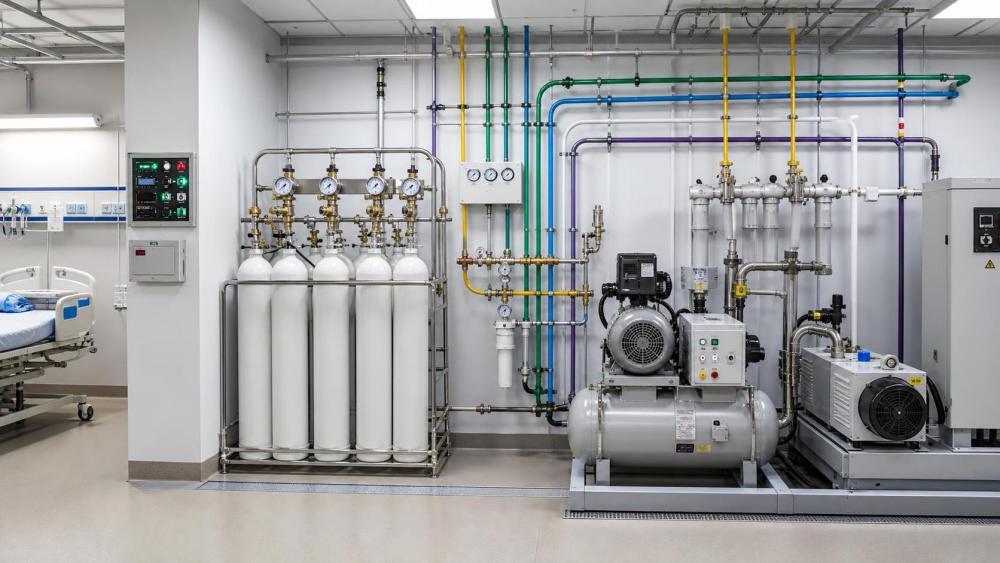
A medical gas system may look compliant at the point of use while still being vulnerable at the source. The source side should be checked for the required capacity, arrangement, reserve supply, and automatic switching where applicable. For oxygen, this may involve a bulk source, manifolds, reserve banks, and controls. For medical air, look at compressors, dryers, receivers, filtration, and dew point control. For vacuum, review pump configuration, receivers, controls, and exhaust arrangements.
The practical question is simple: if one active component fails, does the system continue to support clinical demand long enough and clearly enough for staff to respond safely? NFPA 99 is very focused on continuity, not just installation neatness.
A recurring issue in older hospitals is that source equipment was compliant when the facility load was lower. Additional ventilators, anesthesia workstations, or procedural rooms can change actual demand. If your review only asks whether equipment is present, and not whether it still matches present-day use, you can miss a real risk.
Look closely at piping identification and physical separation
Misidentification remains one of the most serious medical gas hazards. NFPA 99 expects medical gas piping to be clearly identified, and field verification should confirm that labels are legible, correctly placed, and consistent throughout the system. This includes accessible runs above ceilings, in shafts, and at branch lines, not only exposed plantroom piping.
Do not treat labeling as cosmetic. During repairs, renovations, or emergency isolation, technicians often rely on what is visible in the field. Faded labels, painted-over markings, or incomplete branch identification create the conditions for cross-connection mistakes. The same goes for shutoff valves: they need proper identification, accessibility, and alignment with area control plans.
If parts of the installation were modified by different contractors over several years, pay attention to mixed labeling styles or inconsistent color practices. Even when the gas type itself is correct, inconsistency can slow troubleshooting and create avoidable confusion during a critical event.
Check alarms as a functioning safety layer, not just installed devices
Alarm review is where many compliance checks become more meaningful. NFPA 99 requires alarm systems for source equipment and area monitoring, but having alarm panels on the wall is not enough. You need evidence that alarms are active, correctly mapped, audible or visible where required, and understood by the teams expected to respond.
A good check includes three questions. Does the alarm trigger under the expected fault condition? Is the signal transmitted to the right panel or supervisory location? And does the response procedure exist in a form that operations staff can actually follow?
This is especially relevant in facilities where engineering, nursing, and outsourced maintenance providers share responsibilities. Alarm functionality can degrade quietly after control replacements, software updates, panel relocation, or undocumented rewiring. In some hospitals, the panel still powers on and looks normal, but the staff no longer trust it because nuisance alarms were never corrected. Once that happens, a compliant design can turn into an unreliable operating system.
Terminal units and outlets deserve field testing, not assumption
Outlets are where compliance becomes patient-facing. Gas-specific terminal units should be correct for the service, mechanically intact, clearly identified, and verified through testing. If there is one part of the system where assumptions are dangerous, this is it. A room may have been repurposed, a headwall replaced, or a branch modified, and paperwork does not always capture that cleanly.
Field testing should confirm the delivered gas, pressure condition where relevant, and the absence of cross-connections. For safety managers, the key point is traceability. You should be able to follow test records back to specific outlets, zones, and dates, especially after renovation or maintenance work.
The same discipline applies to valve zones and shutoff arrangements. If clinical staff cannot quickly identify which valve isolates which area, the system may satisfy a drawing package but still fail the operational test that matters during an incident.
Review commissioning and verification records with a skeptical eye
NFPA 99 compliance normally involves formal testing and verification, often by qualified personnel independent of the installer. During an audit, ask for the full record trail rather than a final certificate alone. That trail may include brazing procedure records where required, pressure tests, purge documentation, cross-connection tests, standing pressure tests, alarm tests, source equipment startup records, and final verification reports.
The reason to go deeper is straightforward: summary documents can hide scope gaps. If an extension project covered only a new ward, did the final test include the tie-in points? If a vacuum pump skid was replaced, were the alarm and building interface checks repeated? If a contractor changed valve boxes during a remodel, is there a clear re-verification record?
Experienced reviewers do not only ask whether testing happened. They ask whether it happened at the right time, on the right boundaries, and after the last relevant modification.
Maintenance records often reveal more than the acceptance file
A system can pass initial verification and still drift out of compliance over time. That is why preventive maintenance records matter. Review inspection intervals, filter changes, compressor and vacuum pump service logs, alarm checks, valve exercises where applicable, outlet maintenance, calibration records, and any corrective actions tied to gas quality or pressure instability.
What you are really looking for is control over change. Were failures analyzed? Were replacement parts equivalent and documented? Were temporary bypasses removed and closed out? In many healthcare facilities, the highest risk is not gross neglect but accumulated small changes that nobody fully reassembled into a current system picture.
This is one reason structured B2B healthcare information is valuable beyond procurement. In medical infrastructure, long-term operational value depends on service support, documentation readiness, and maintenance clarity just as much as on initial purchase specifications. That is a recurring theme in MTHH’s hospital infrastructure coverage, and it matches what compliance teams see in real projects.
A practical audit checklist
Where teams usually underestimate the risk
The most common mistake is treating compliance as a construction milestone rather than a managed condition. The second is relying too heavily on drawings that were never fully updated after site changes. Another is assuming that gas quality, pressure, and alarms are engineering-only issues. In reality, they affect anesthesia delivery, ventilator performance, suction reliability, and response speed during emergencies.
If you are checking a facility with mixed-age infrastructure, outsourced maintenance, or ongoing renovation, be cautious about simple pass-fail judgments. Some findings call for immediate correction; others require a scoped re-verification project. The right response depends on what part of the system is affected and whether patient care areas are exposed.
A solid NFPA 99 review is not the one with the thickest binder. It is the one that can show, with current evidence, that the gas reaching the bedside is the right gas, at the right condition, from a source and distribution network that staff can monitor, isolate, and maintain without guesswork. If your records cannot support that conclusion, the next step is usually not more paperwork. It is targeted field verification.
Have questions about the global trade trends discussed here, or planning your expansion and supply chain strategy? Leave a message below and let the trade experts at MTHH guide you.
We respect your privacy. Your information is strictly confidential.
Related News
- FDA Issues Benefit-Risk Discussion Paper on Robotic Medical DevicesNov 07, 2026Explore the FDA discussion paper on robotic medical devices, its potential benefit-risk implications, and what manufacturers and purchasers should monitor.
- How to select ISO standards for medical device performance evaluationNov 06, 2026Choose medical device performance evaluation ISO standards with confidence. Learn to match claims, test methods, and regulatory requirements to reliable evidence.
- FDA Updates QMSR FAQs and Medical Device Cybersecurity GuidanceNov 06, 2026FDA QMSR FAQs and medical device cybersecurity guidance: Explore potential implications for ISO 13485 alignment, compliance planning and supplier coordination.
- Philips Reaches €288 Million Settlement in US Respiratory Device Recall ProbeNov 05, 2026Philips reaches a €288 million US settlement over its respiratory device recall. Explore the financial impact and implications for manufacturers.