
How to check whether a medical device technical files template meets EU MDR requirements
Technical evaluation teams usually search for a medical device technical files template when they need speed and structure. The real question, however, is not whether a template exists. It is whether that template can support an EU MDR-compliant submission without creating hidden gaps that surface later during notified body review, importer due diligence, distributor onboarding, or internal design control checks.
That distinction matters. Many templates look organized because they contain familiar headings such as device description, labeling, risk analysis, and clinical data. But EU MDR review does not stop at headings. Reviewers look for traceability, consistency, evidence quality, and the logic connecting design, intended purpose, risk controls, verification, clinical justification, and post-market follow-up. A file can appear complete on paper and still be weak where it matters most.
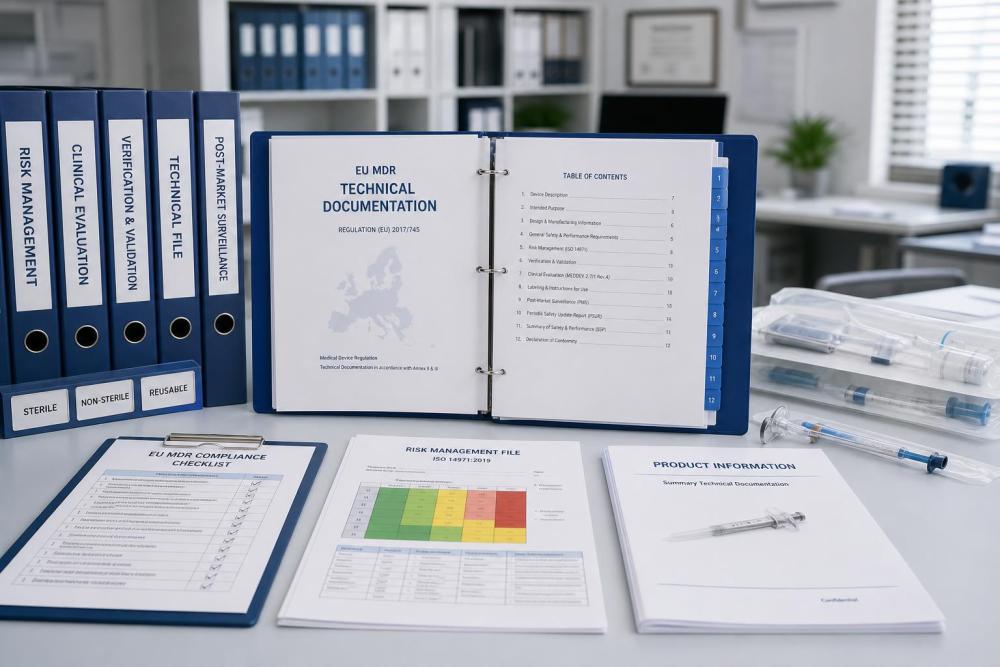
For manufacturers, regulatory consultants, and technical reviewers, the practical task is to determine whether a template is only a document shell or whether it reflects the actual structure and evidence expectations of Regulation (EU) 2017/745 and its related guidance. That is the standard worth checking before anyone starts populating hundreds of pages of content.
A template is useful only if it reflects review logic, not just document order
Under EU MDR, technical documentation is not simply a binder of records. It is a controlled body of evidence showing that the device meets the applicable general safety and performance requirements, that the manufacturer understands its risks, and that the supporting data remain appropriate throughout the product lifecycle.
That means a strong template should guide users to answer linked questions, not just upload files into isolated sections. If the intended purpose changes, can the template force review of clinical evaluation, labeling, usability, risk management, software validation, and post-market surveillance assumptions? If a design change affects materials or performance claims, does the structure reveal which reports and declarations must also be updated? If not, the template may support filing, but not compliance management.
In practice, technical teams often inherit templates from consultants, former projects, or legacy MDD-era files. Those documents may still contain useful content, but they should not be assumed to match current MDR expectations. The risk is especially high for borderline devices, software, combination products, reusable surgical instruments, and products relying on equivalence or limited clinical evidence.
What the searcher usually wants to know
People looking for this topic are rarely asking for a definition of technical documentation. They are usually trying to judge one of three business questions.
- Can this template support a real CE marking project under MDR, or is it only an internal formatting tool?
- Will using it reduce regulatory workload, or will it create rework during conformity assessment?
- Is it suitable for this device type, classification, and evidence strategy?
Those are reasonable concerns because technical documentation affects more than market access. It also affects distributor confidence, investor diligence, product transfer, complaint handling, and the speed of responding to authority or notified body questions. A weak template becomes expensive when multiple departments start relying on it.
The first check: does it map to Annex II and Annex III in substance
The most basic review point is whether the template aligns with the core MDR structure, especially Annex II and Annex III. This sounds obvious, but many templates only mirror the section titles at a high level. That is not enough.
A usable template should break those annex expectations into practical document prompts. For example, “device description” should not stop at a product overview. It should lead users to define variants, accessories, UDI-related identification elements where applicable, intended users, intended patient population, operating principles, configuration logic, and relevant previous or similar generations where comparison is needed.
The same applies to Annex III. A post-market surveillance section should not be a placeholder named “PMS plan.” It should help teams connect complaint sources, vigilance triggers, trend reporting logic, PMCF assumptions where relevant, and the way post-market evidence feeds back into risk management and clinical evaluation.
If a template claims MDR readiness but does not clearly operationalize Annex II and Annex III, treat that as an early warning sign.
GSPR mapping is one of the quickest ways to detect template quality
One of the most common weaknesses in a medical device technical files template is poor treatment of the General Safety and Performance Requirements. A mature template should not present GSPR as a simple checklist with yes or no answers. It should support a traceable matrix.
That matrix should allow teams to identify which requirements apply, explain non-applicability where justified, and link each applicable requirement to the exact evidence used to demonstrate conformity. Those links may include standards, test reports, biocompatibility assessments, software lifecycle records, usability files, sterilization validation, shelf-life studies, electrical safety reports, or clinical evaluation conclusions, depending on device type.
If the template only provides a broad summary table without evidence references, version control prompts, or rationale fields, it may look tidy but fail during review. Notified bodies generally expect traceability, and internal technical reviewers need the same traceability to detect unsupported claims before external review begins.
A useful test is simple: can a reviewer start from a single GSPR item and quickly find the exact document, report version, and acceptance logic behind the claim of conformity? If not, the template is probably too superficial.
Risk management should be integrated, not parked in one section
Many templates include a risk management chapter because they know ISO 14971 is central to device compliance. The problem is that some templates isolate risk into one document slot and fail to connect it to the rest of the file.
Under MDR, risk management is not a stand-alone attachment. It should inform design inputs, verification planning, residual risk communication, labeling, usability work, cybersecurity considerations where relevant, clinical benefit-risk conclusions, and post-market follow-up activities. A template that handles risk correctly will create prompts across sections, not only inside a risk chapter.
Technical evaluation teams should look for signs that the template forces cross-reference between:
- hazards and risk control measures,
- risk controls and verification evidence,
- residual risks and labeling or IFU warnings,
- clinical benefits and overall benefit-risk conclusion,
- post-market findings and risk file updates.
If those connections are missing, the template may still produce a file, but not a persuasive one.
Clinical evaluation support is where many templates become misleading
Some technical files templates advertise themselves as complete because they contain a section titled “Clinical Evaluation Report.” That can be misleading. Clinical evaluation under MDR is not satisfied by inserting a CER heading into the folder structure.
A serious template should help the team define the device’s clinical claims, intended purpose, state of the art context, applicable clinical endpoints, data sources, equivalence strategy if used, and the logic for identifying evidence gaps. It should also signal where PMCF may be needed rather than treating it as an optional afterthought.
This is especially important for devices that rely on literature, mature technology arguments, or comparison to prior generations. A template that does not prompt reviewers to examine claim-by-claim evidence support can encourage weak conclusions. That weakness may remain hidden until a notified body challenges the sufficiency of the clinical rationale.
For technical assessors, a practical question is whether the template distinguishes between administrative completion and evidentiary sufficiency. Many do the first. Fewer support the second.
Check whether the template is device-specific enough to be usable
There is no universal technical documentation template that works equally well for an infusion pump, imaging workstation, sterile single-use consumable, IVD analyzer, and AI-enabled software module. A generic structure can be useful at framework level, but if it is too generic, teams spend more time adapting it than benefiting from it.
The right level of specificity depends on product complexity. For software, reviewers may need structured prompts for architecture, cybersecurity, interoperability, revision control, anomaly resolution, and validation in the intended environment. For sterile devices, the template should account for packaging validation, sterilization method, transport integrity, and shelf-life justification. For electrical equipment, links to EMC and safety evidence may need clearer treatment. For devices used in hospital infrastructure or connected clinical systems, installation conditions and interface assumptions may also be relevant.
A template that ignores these distinctions often creates a false sense of readiness. It is better to use a modular template with device-specific annexes than a one-size-fits-all package that obscures critical evidence needs.
Version control, ownership, and update triggers are compliance issues, not admin details
Another reliable indicator of template maturity is whether it manages document control properly. MDR compliance depends on current, coherent documentation. A technically strong file can quickly become unreliable if ownership, revision status, approval logic, and change impact rules are vague.
Technical teams should check whether the template includes fields or instructions for document owner, approver, effective version, linked change record, and periodic review trigger. It should also show when a change in design, materials, intended purpose, supplier, software build, complaint trend, or standards status requires reassessment of related sections.
This matters beyond regulatory inspection. In distribution partnerships, OEM-private label arrangements, and multi-market expansion, documentation often moves between teams. Without strong control logic, consistency degrades fast.
What a practical evaluation checklist looks like
When reviewing a template before adoption, technical evaluation teams can use a simple set of decision questions.
If the answer is weak in several of these areas, the template may still be salvageable, but it should not be treated as submission-ready.
Common assumptions that do not fully hold in practice
One common assumption is that a template sold as “EU MDR compliant” has already solved the regulatory interpretation problem. It has not. Compliance depends on the content, rationale, and maintenance process behind the template.
Another assumption is that a larger template is automatically safer. In reality, overbuilt templates often bury critical issues under administrative text. Reviewers then spend time navigating filler while missing the quality of the evidence itself.
A third assumption is that if a template worked for one device, it can be cloned across the portfolio. Sometimes that is efficient. Sometimes it imports the wrong logic into a different classification, clinical claim set, or manufacturing configuration. Template reuse should be controlled, not automatic.
What should matter most for technical evaluation teams
For technical assessors, the best template is not the one with the most pages. It is the one that helps the organization maintain a defensible line from intended purpose to conformity evidence and then keep that line current as the product evolves.
That has direct business implications. A capable template can reduce review friction, improve internal handoffs, and support cleaner communication with notified bodies and commercial partners. A weak one can delay submissions, trigger avoidable questions, and make post-market updates harder than they should be.
So the right decision is usually not “Do we have a medical device technical files template?” but “Does this template reflect how MDR compliance is actually reviewed for this device and this business model?” That is the question worth resolving before teams start filling in sections and assuming the structure itself is proof of readiness.
Have questions about the global trade trends discussed here, or planning your expansion and supply chain strategy? Leave a message below and let the trade experts at MTHH guide you.
We respect your privacy. Your information is strictly confidential.
Related News
- Hong Kong Outlines Medical Device Legislation and Plans for Statutory RegulatorNov 14, 2026Hong Kong medical device legislation could reshape regulatory oversight. Explore the proposed regulator and what businesses should monitor.
- AAMI Issues TIR115 Guidance on Public Cloud Use in Medical DevicesNov 13, 2026AAMI TIR115:2026 guides public cloud use in medical devices. Explore its focus on risk management, supplier assessment and device boundaries.
- How are critical care devices regulated in the United States?Nov 12, 2026Critical care devices face FDA requirements based on intended use and risk. Explore classifications, marketing pathways, and practical compliance checks.
- Hong Kong Drafts Medical Device Bill to Establish Statutory OversightNov 12, 2026Hong Kong's Medical Devices Bill could introduce risk-based statutory oversight. Discover what the proposed framework may mean for suppliers.