
How to Evaluate a Medical Equipment Service Provider for Compliance and Uptime
Choosing the right medical equipment service provider is critical for healthcare organizations that must balance regulatory compliance, equipment uptime, and long-term operating value. For technical evaluation teams, the decision goes far beyond basic maintenance pricing. It requires a clear review of service capability, response speed, documentation quality, training support, spare parts availability, and risk control to ensure medical systems remain safe, reliable, and ready for clinical use.
When users search for guidance on evaluating a medical equipment service provider, their core intent is practical. They want a reliable framework for comparing providers, identifying compliance risks, and protecting equipment uptime before signing a service agreement. They are not looking for generic definitions. They need criteria that can be used in technical assessment, procurement review, and supplier selection.
For technical evaluation personnel, the biggest concerns are usually straightforward. Can the provider keep the device operational, support inspections and audits, respond fast enough during failures, document service correctly, and reduce long-term operational risk? They also need to know whether the provider understands the specific device category, from imaging systems to laboratory analyzers or patient monitoring equipment.
The most useful content for this audience is decision-oriented content. That means measurable evaluation points, service-level questions, red flags, compliance checkpoints, and a clear distinction between a low-price vendor and a capable long-term service partner. The sections below focus on those issues, while avoiding broad marketing language that does not help technical review.
Start with the Two Questions That Matter Most: Compliance and Clinical Uptime
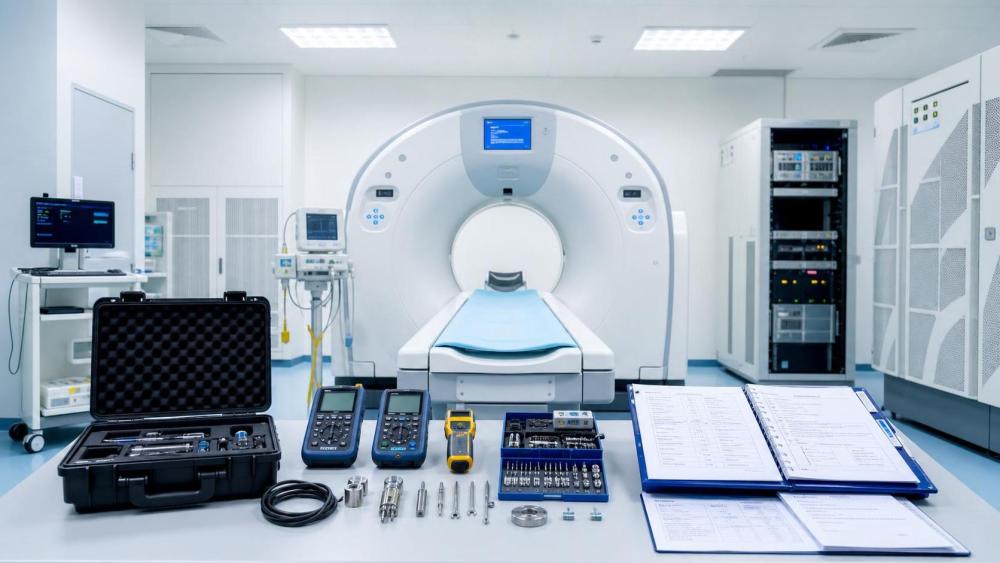
The best medical equipment service provider is not simply the one with the lowest contract price. It is the provider that can maintain regulatory readiness while keeping equipment available for clinical use. These two outcomes should guide the entire evaluation process.
Compliance matters because medical equipment service affects patient safety, device traceability, preventive maintenance records, calibration status, software control, and incident response. If service documentation is incomplete or maintenance practices do not align with local regulations, the hospital may face audit exposure, insurance issues, or operational disruption.
Uptime matters because clinical departments depend on stable equipment access. A CT scanner, ventilator, biochemistry analyzer, or sterilizer that stays out of service too long can delay diagnosis, reduce procedure capacity, increase referral costs, or create workflow bottlenecks across the facility.
Technical evaluation teams should therefore begin with a simple test. Can the provider demonstrate a repeatable system for compliant service delivery, and can it show evidence of strong uptime performance on comparable equipment? If the answer is weak in either area, the supplier should be treated cautiously.
Review Whether the Provider Truly Understands the Equipment Category
Not every service organization is equally capable across all device classes. A provider that performs well on infusion pumps may not be the right fit for MRI systems, molecular diagnostics, digital radiography, or anesthesia workstations. Technical depth must match equipment complexity.
Start by checking the provider’s experience within the exact category under review. Ask how many similar systems are under contract, which manufacturers are covered, what failure modes are most common, and how the provider handles calibration, parts replacement, software support, and performance verification.
Category-specific knowledge is especially important for high-dependency equipment. Imaging systems require knowledge of detectors, generators, dose-related performance, software updates, room constraints, and image quality checks. Laboratory instruments need control over calibration, throughput issues, reagent compatibility, and quality assurance workflows.
A capable medical equipment service provider should also understand how the device is used in the care environment. Technical service is not only about replacing parts. It should account for operator workflow, maintenance windows, contamination control, data integration, and the consequences of downtime on clinical operations.
Check Regulatory and Quality System Readiness in Detail
Compliance should be verified through evidence, not verbal claims. Technical evaluation teams should request documentation that shows how the provider controls preventive maintenance, service reports, calibration references, technician qualifications, complaint handling, and parts traceability.
Depending on the market, relevant quality indicators may include alignment with ISO 13485 processes, field service procedures, electrical safety testing protocols, cybersecurity update control, and documented escalation pathways for serious device events. The exact regulatory framework will vary, but the need for documented discipline is universal.
Review the structure of the provider’s service records. Good records usually include asset identification, serial number confirmation, work performed, test results, replaced parts, engineer identity, date and time stamps, and recommended next actions. Weak service records often create major problems during internal audits or external inspections.
Technical teams should also ask how the provider manages recalls, safety notices, and manufacturer advisories. If a service partner cannot clearly explain how it receives, reviews, and acts on field safety information, the risk to the healthcare organization is materially higher.
Evaluate Response Time, Escalation Logic, and Service Coverage
Uptime depends on more than technician skill. It also depends on how quickly the provider can respond, diagnose, escalate, and resolve faults. Service capability should therefore be reviewed as an operating system, not just as a labor offer.
Key questions include response time by equipment criticality, onsite coverage area, availability outside standard hours, remote troubleshooting capability, and access to higher-level technical support. A provider serving ICU ventilators or emergency imaging should not be assessed the same way as one serving low-risk ancillary devices.
Ask for service-level commitments in measurable terms. These may include telephone response time, onsite attendance window, maximum downtime thresholds, first-time fix rate, and preventive maintenance completion targets. If the service agreement uses vague language, the operational risk stays with the buyer.
Escalation structure is another useful indicator. A mature provider can explain what happens when first-line support fails, how specialist engineers are engaged, how manufacturer support is accessed, and how communication is maintained with the hospital’s technical and clinical stakeholders throughout the incident.
Confirm Spare Parts Access and Supply Chain Reliability
Many service contracts appear strong on paper but fail in practice because parts are slow, unavailable, or poorly controlled. For critical systems, spare parts access can be the difference between a short interruption and a prolonged outage.
Technical evaluators should ask whether the provider uses original parts, approved equivalents, or mixed sourcing. They should also review local stock availability, lead times for common failures, procedures for obsolete components, and controls for part authenticity and traceability.
This is particularly important for aging fleets. Older ultrasound systems, monitors, sterilizers, or analyzers may have limited manufacturer support. In these cases, the provider should demonstrate a realistic strategy for sustaining service, including risk disclosure, repair limitations, and recommendations for replacement planning.
A dependable medical equipment service provider will be transparent about supply limitations. Overpromising on parts availability usually signals future service instability. Clear communication is more valuable than broad promises that cannot be fulfilled under actual field conditions.
Look Closely at Documentation, Reporting, and Audit Support
Technical teams often focus heavily on repair capability and overlook the administrative side of service. That is a mistake. In regulated healthcare environments, documentation quality is part of service quality.
Ask to review sample preventive maintenance reports, corrective maintenance reports, calibration certificates, and asset history summaries. These documents should be readable, consistent, technically meaningful, and suitable for hospital recordkeeping. Poorly written reports usually reflect weak process control behind the scenes.
The provider should also be able to support internal asset management. Useful capabilities include digital service history, maintenance scheduling support, failure trend reporting, open corrective action tracking, and recommendations for lifecycle planning based on repair frequency and cost behavior.
Audit support matters as well. During accreditation reviews or quality inspections, hospitals may need quick access to maintenance records and service status evidence. A provider that cannot retrieve records efficiently creates unnecessary compliance pressure for the customer.
Assess Training Support and Knowledge Transfer
Good service support does not stop at maintenance visits. Technical evaluation teams should examine whether the provider can strengthen local capability through operator guidance, user error reduction, and practical knowledge transfer to biomedical staff.
Some failures are not true equipment defects. They may result from incorrect setup, poor cleaning practices, accessory misuse, alarm misunderstanding, or skipped routine checks. A service partner that can identify and address these issues helps reduce avoidable downtime.
Ask whether the provider offers refresher training after installation, post-repair user guidance, or technical briefings for biomedical engineering teams. For complex equipment, this support can improve first-line troubleshooting and reduce dependence on emergency callouts.
Training also has a compliance dimension. Where maintenance or user checks require documented competency, the provider should clarify what training materials are available and how technical instruction is recorded. This becomes especially relevant in high-risk care areas and tightly audited laboratory settings.
Compare Total Service Value, Not Just Contract Price
Price matters, but technical evaluators should resist judging service offers by annual fee alone. A lower-cost provider may generate higher total cost if downtime increases, repeat visits rise, documentation fails audits, or spare parts delays affect clinical throughput.
A better comparison model includes preventive maintenance coverage, emergency response terms, included parts, software support, calibration scope, training support, reporting quality, and exclusions that may create unexpected extra charges. These details often explain why quotes differ.
It is also useful to estimate the operational cost of downtime. For example, one day of lost diagnostic output from a busy imaging or laboratory department may exceed the apparent savings of a cheaper contract. Service evaluation should therefore connect technical performance with business impact.
The strongest provider is often the one that lowers risk-adjusted operating cost over time. That includes fewer failures, faster recovery, better compliance support, and more predictable lifecycle planning. For hospitals and distributors, those benefits are usually more valuable than a narrow reduction in service fees.
Use a Practical Evaluation Checklist Before Final Selection
Before approving a medical equipment service provider, technical teams should convert their review into a structured checklist. This reduces subjective judgment and helps procurement, engineering, and management teams align around the same decision criteria.
A practical checklist should cover equipment-specific experience, technician qualifications, preventive maintenance protocols, response time commitments, escalation routes, spare parts strategy, documentation samples, audit support, training capability, software and cybersecurity handling, and references from comparable installations.
It is also wise to request evidence from real operating environments. Case references, sample service metrics, uptime reports, and client feedback from similar hospitals or laboratories can reveal whether the provider performs consistently beyond the sales process.
Finally, technical evaluators should document key risks clearly. If the provider has limited territory coverage, weak OEM access, uncertain spare parts sourcing, or incomplete reporting systems, those issues should be recorded before contract award. Good decisions become easier when risk is made visible early.
Conclusion
Evaluating a medical equipment service provider is fundamentally a risk and performance decision. The right partner supports regulatory readiness, protects clinical uptime, improves service visibility, and reduces long-term operational uncertainty across the equipment lifecycle.
For technical evaluation teams, the most effective approach is evidence-based and practical. Focus on equipment-category expertise, documented quality systems, measurable response performance, spare parts reliability, reporting discipline, and user support. These factors say far more about service value than pricing alone.
In healthcare environments, service quality directly influences safety, workflow continuity, and asset value. A provider that can prove compliant processes and dependable uptime support is not just a vendor. It is a strategic operational partner for hospitals, laboratories, distributors, and healthcare project planners.
Have questions about the global trade trends discussed here, or planning your expansion and supply chain strategy? Leave a message below and let the trade experts at MTHH guide you.
We respect your privacy. Your information is strictly confidential.
Related News
- FDA Issues Benefit-Risk Discussion Paper on Robotic Medical DevicesNov 07, 2026Explore the FDA discussion paper on robotic medical devices, its potential benefit-risk implications, and what manufacturers and purchasers should monitor.
- How to select ISO standards for medical device performance evaluationNov 06, 2026Choose medical device performance evaluation ISO standards with confidence. Learn to match claims, test methods, and regulatory requirements to reliable evidence.
- FDA Updates QMSR FAQs and Medical Device Cybersecurity GuidanceNov 06, 2026FDA QMSR FAQs and medical device cybersecurity guidance: Explore potential implications for ISO 13485 alignment, compliance planning and supplier coordination.
- Philips Reaches €288 Million Settlement in US Respiratory Device Recall ProbeNov 05, 2026Philips reaches a €288 million US settlement over its respiratory device recall. Explore the financial impact and implications for manufacturers.