
For medical device leaders, supply chain disruption is no longer only an operations issue. It can directly determine whether a product reaches hospitals, maintains registrations, and remains commercially viable.
A delayed semiconductor, unavailable sterile packaging material, or discontinued sensor can interrupt manufacturing. Yet the larger commercial consequence is often delayed market access, lost tenders, and weakened distributor confidence.
Unlike many consumer products, medical devices cannot simply be substituted with another component overnight. Every material, supplier, software version, and production location may affect compliance obligations.
Business decision-makers therefore need to evaluate disruption through a market access lens. The relevant question is not merely whether production can continue, but whether customers can receive supported products.
In the medical device industry supply chain, market access depends on coordinated performance across manufacturing, regulatory affairs, quality, logistics, service, procurement, and local distribution partners.
When one link fails, the impact can spread beyond a missed shipment. It may affect product availability, contract fulfillment, hospital planning, post-market obligations, and future commercial opportunities.
Why Supply Chain Disruption Becomes a Market Access Problem
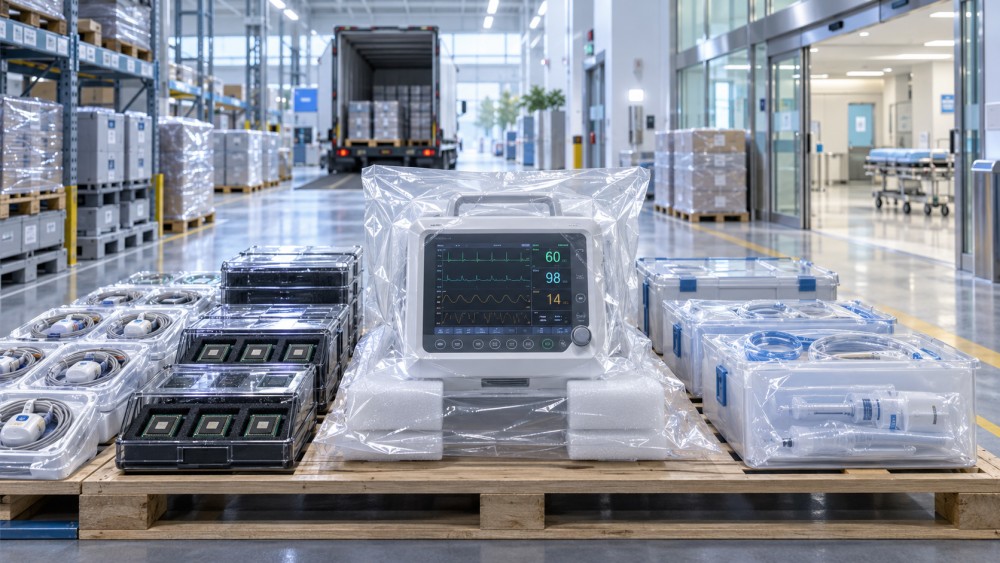
Medical device market access is commonly associated with registration, clinical evidence, reimbursement, and local approval. However, approved products still need reliable production, delivery, installation, and after-sales support.
A manufacturer may hold a valid registration but lack critical components needed to build the approved configuration. In practical terms, that product may be unavailable to the market.
For hospitals, availability is only one part of access. Buyers also need certainty around commissioning, training, maintenance, spare parts, consumables, software updates, and warranty coverage.
For distributors, supply disruption creates a similar challenge. They may have committed equipment quantities, service response times, or project schedules without sufficient control over upstream supply.
Medical equipment purchasing decisions often involve long planning cycles. A delayed imaging system, laboratory analyzer, ventilator, or sterilizer can affect clinical capacity and capital expenditure timing.
These consequences make customers more cautious. Hospitals may choose suppliers with stronger local inventory, established service teams, or proven component continuity, even when initial prices are higher.
Supply disruption can also change tender competitiveness. If delivery dates become uncertain, a technically strong product may lose against a less sophisticated but more reliable alternative.
Market access therefore includes commercial credibility. Manufacturers must demonstrate that they can deliver equipment, sustain its lifecycle, and protect healthcare operations after the purchase order is signed.
Which Disruptions Create the Greatest Commercial Risk?
Not every shortage has the same business impact. Decision-makers should distinguish between disruptions that reduce efficiency and those that threaten product compliance, patient safety, or contractual delivery.
Critical electronic components are a major concern for patient monitors, diagnostic imaging systems, infusion pumps, ventilators, laboratory automation, and connected digital health equipment.
When chips, sensors, displays, batteries, or communication modules become constrained, manufacturers may face redesign decisions. Those decisions can trigger verification, validation, and regulatory review requirements.
Single-source materials create another high-risk category. Specialized polymers, adhesives, sterile barriers, optics, reagents, detector materials, and precision mechanical parts may have limited qualified suppliers.
For in vitro diagnostics, reagent supply can be more commercially sensitive than instrument delivery. Hospitals rely on continuing reagent availability to maintain routine testing and reporting workflows.
Packaging and sterilization disruptions also matter. A device may be fully manufactured but unable to ship if validated packaging, sterilization capacity, labels, or transportation conditions are unavailable.
Logistics disruptions can be especially damaging for high-value systems requiring controlled transportation, customs documentation, installation coordination, and site readiness checks before delivery.
Software dependencies deserve equal attention. A hardware shipment can lose commercial value when cybersecurity patches, cloud services, licenses, localization, or interoperability tools are delayed or unsupported.
How Component Changes Can Delay Regulatory and Commercial Launches
A common leadership mistake is treating alternate sourcing as a purely procurement decision. In medical devices, supplier changes can affect the product’s approved design and quality documentation.
Replacing a component may alter performance, biocompatibility, electromagnetic compatibility, electrical safety, shelf life, packaging integrity, or clinical workflow characteristics.
The level of regulatory impact depends on the device, target jurisdiction, intended use, and nature of the modification. Some changes require documented internal assessment, while others require formal notification.
Even where new approval is not required, the manufacturer must retain evidence showing that the modified product remains safe, effective, and compliant with applicable specifications.
This creates a time-cost tradeoff. An alternate supplier may reduce shortage exposure, but qualification work can consume engineering capacity and postpone the commercial recovery expected from switching.
Quality teams must assess supplier controls, incoming inspection methods, traceability, change notifications, and corrective action history. Regulatory teams must connect those findings to market-specific requirements.
Commercial leaders should be involved early because the chosen solution affects launch dates, customer communications, pricing, inventory allocation, and contractual commitments in multiple countries.
Strong governance prevents a rushed sourcing decision from becoming a larger market access problem. The best response balances continuity needs against validation burden and downstream business exposure.
Why Service Continuity Matters as Much as New Equipment Sales
Market access does not end when a device enters a country or reaches a hospital loading dock. For capital equipment, long-term service capability is part of the buyer’s decision.
Hospitals evaluate whether a supplier can provide preventive maintenance, corrective repair, application support, calibration, software updates, and replacement parts throughout the installed lifecycle.
A supply interruption affecting spare parts can create serious commercial damage. Equipment downtime may delay diagnosis, disrupt surgery schedules, reduce laboratory throughput, or increase patient transfer requirements.
Clinical engineering departments often remember service failures longer than product demonstrations. A manufacturer that cannot repair installed equipment may struggle to win future tenders or expand accounts.
Distributors face particular pressure because they are usually the visible local party. Even when the root cause sits upstream, hospitals expect the distributor to provide clear answers and recovery plans.
For this reason, spare-parts planning should be separated from finished-goods forecasting. Installed-base data, failure patterns, service-level agreements, and equipment age should guide inventory decisions.
Critical parts should receive priority classification based on clinical risk, repair lead time, installed-base volume, alternative availability, and the consequences of equipment downtime.
Leaders should also review service documentation readiness. Technicians need current manuals, diagnostic tools, software access, training records, and escalation routes to resolve problems efficiently.
How Supply Disruption Changes Hospital Procurement Decisions
Hospital procurement teams increasingly assess supply resilience during supplier evaluation. They want evidence that suppliers can support delivery schedules, essential consumables, service commitments, and operational continuity.
Price remains important, but total operating risk has become more visible. A lower-cost device can become expensive when delayed installation, unavailable reagents, or repeated service interruptions affect care delivery.
Procurement officers may request inventory information, manufacturing lead times, local service capacity, alternative product configurations, and contingency plans before awarding major contracts.
For equipment projects, hospitals also examine implementation dependencies. Room construction, power requirements, medical gas systems, IT integration, operator training, and acceptance testing require coordinated schedules.
When manufacturers cannot provide reliable schedules, project planners may delay approval or select suppliers with less uncertainty. This can affect access to strategically important health systems.
Distributors should prepare transparent, defensible answers rather than optimistic assurances. Customers usually accept a difficult situation more readily when they receive accurate dates and practical alternatives.
Decision-makers should view this as a trust issue. Consistent communication, realistic allocation rules, and documented support plans can preserve relationships when supply conditions are genuinely constrained.
In many cases, a well-managed shortage creates less reputational damage than poor communication. Hospitals need reliable information to protect patient care, staffing, and budget planning.
Building Resilience Across the Medical Device Industry Supply Chain
Resilience begins with visibility. Leadership teams need a clear view of critical components, approved suppliers, manufacturing sites, inventories, transport routes, and affected product families.
A practical risk map should identify which parts can stop production, delay shipment, compromise service obligations, or require regulatory assessment when substituted.
Risk should not be measured only by purchase value. Low-cost components can create high exposure when they are single-sourced, difficult to qualify, or essential to device operation.
Dual sourcing is valuable when technically and economically realistic. However, a second supplier only improves resilience when qualification, documentation, quality controls, and volume capacity are genuinely established.
Manufacturers should avoid treating approved alternates as inactive paperwork. Supplier performance, capacity changes, geopolitical exposure, and quality trends should be reviewed before an emergency occurs.
Strategic inventory is another useful tool, especially for critical spare parts, long-lead electronics, sterile consumables, and high-demand diagnostic reagents. Inventory decisions require disciplined financial analysis.
Holding more stock increases working capital and obsolescence risk. Yet insufficient stock can cost far more through missed sales, contract penalties, emergency logistics, and damaged customer relationships.
The appropriate inventory level depends on product criticality, forecast reliability, shelf life, storage requirements, supplier lead time, local demand volatility, and expected service commitments.
What Executives Should Ask Before Entering or Expanding a Market
Before launching a product in a new market, executives should confirm whether the supply model can support the full commercial promise, not only the first shipment.
The first question is whether the approved product configuration can be produced reliably. This includes components, labels, language variants, accessories, packaging, and market-specific documentation.
The second question is whether local partners can meet installation and service obligations. A capable distributor needs trained personnel, spare-parts access, technical tools, and clear escalation procedures.
The third question concerns consumables and recurring supplies. Diagnostic platforms, sterilization systems, monitoring accessories, and many treatment devices depend on predictable replenishment after installation.
The fourth question is whether contract terms reflect realistic supply exposure. Delivery deadlines, penalty clauses, minimum stock commitments, and service-level agreements should align with actual operating capability.
The fifth question is how changes will be managed. Leaders need a defined process linking procurement, engineering, quality, regulatory affairs, commercial teams, and distributor communication.
These questions are especially important in public tenders and large hospital projects. Winning the order without a credible fulfillment model can create financial loss and long-term reputational harm.
A disciplined market access assessment should therefore combine regulatory readiness, supply feasibility, local service capacity, customer expectations, and lifetime support economics.
Turning Supply Resilience Into Commercial Advantage
Supply resilience can become a meaningful commercial differentiator when it is supported by evidence. Hospitals and distributors value suppliers that explain how continuity risks are identified and managed.
This does not require disclosing confidential supplier details. It requires showing that the business has realistic controls for critical inventory, change management, service support, and customer communication.
Manufacturers can strengthen proposals by defining lead times clearly, identifying installation prerequisites, outlining service coverage, and explaining consumable replenishment arrangements before contract signature.
For distributors, resilience improves portfolio quality. Products with stable technical documentation, manufacturer support, spare-parts availability, and responsive training programs are easier to sell and sustain.
Healthcare buyers benefit when suppliers describe operational limitations honestly. This allows procurement and clinical engineering teams to make better comparisons based on total lifecycle value.
Executives should track resilience using business indicators, not only supply metrics. Useful measures include missed delivery rates, service downtime, alternate-source qualification time, and lost-tender reasons.
They should also examine customer-facing consequences, including delayed installations, backordered consumables, unresolved repairs, contract exceptions, and distributor satisfaction across priority markets.
These indicators connect supply chain decisions to market access outcomes. They help leadership allocate resources toward the risks that can most directly restrict revenue and customer confidence.
Conclusion: Protecting Access Means Protecting the Entire Device Lifecycle
Supply chain disruptions affect medical device market access because healthcare customers purchase more than a physical product. They purchase dependable clinical capability, service continuity, and long-term support.
For leaders in the medical device industry supply chain, the strongest response is cross-functional. Procurement, quality, regulatory, commercial, service, and distribution teams must operate from shared priorities.
Alternative sourcing, inventory buffers, documentation control, local service readiness, and transparent customer communication all contribute to a more credible market access strategy.
The key business judgment is straightforward: a product is not fully accessible simply because it is approved or manufactured. It is accessible when customers can receive, operate, maintain, and trust it.