
How can hospitals reduce delays in an emergency care systems workflow?
Delays in emergency care rarely come from one dramatic failure. More often, they build up through small interruptions: a patient is triaged but not reassessed, a monitor is unavailable or not connected, a blood sample waits for collection, a scan is requested without a clear transport plan, or a clinical decision is made but not communicated to the next team.
A faster emergency care systems workflow is therefore not simply a matter of adding staff or buying more equipment. Hospitals reduce delays when triage, monitoring, diagnostics, treatment spaces, equipment readiness, and handoffs work as one operational sequence. The aim is to remove avoidable waiting while preserving the time needed for safe assessment and clinical judgment.
The most useful starting point is to identify where a patient stops moving forward. This means looking beyond overall crowding and tracing the actual route from arrival to disposition: registration, first assessment, initial observations, diagnostics, treatment, specialist review, admission, transfer, or discharge. A delay that appears to be caused by “high patient volume” may instead be caused by unclear ownership, missing equipment, duplicated documentation, or results that are available but not seen promptly.
Begin with the points where flow breaks
An emergency department workflow should not be reviewed only from the perspective of total length of stay. That measure is useful, but it does not explain what staff can change during a shift. A more practical review asks four questions at every handoff:
- Who is responsible for the next action?
- What information must be available before that action can happen?
- What device, room, supply, or support service is required?
- What should trigger escalation if the action does not happen?
For example, a patient may be waiting for imaging because the imaging request was entered late, because transport was not arranged, because the patient has not been reassessed for stability, or because the receiving area does not know the patient is ready. These are different problems. Buying another scanner will not resolve a communication or transport problem.
Map the workflow using real shift conditions, including peak arrival periods, staff changes, isolation needs, equipment cleaning, and bed shortages. A process that works on paper but fails during a busy evening is not a reliable emergency workflow. The review should include the physical route as well: distance to treatment rooms, supply storage, point-of-care testing locations, imaging access, and the route to critical care or inpatient units.
Make triage a living process, not a one-time event
Triage determines where attention begins, but it should not become a static label attached at arrival. Patients can deteriorate while waiting, and a patient whose initial presentation appeared less urgent may need reassessment before a queue becomes dangerous. Clear reassessment ownership reduces the chance that waiting patients become invisible between registration and treatment.
A workable approach separates three actions: initial sorting, early clinical assessment, and ongoing reassessment. Initial sorting identifies immediate threats and directs patients to the appropriate area. Early assessment establishes the initial plan, such as monitoring, tests, pain management, or observation. Reassessment checks whether the plan remains appropriate while the patient waits.
Delays increase when these steps are mixed together without defined triggers. If staff must rely on memory to decide who needs a repeat set of vital signs or who is waiting for a result, important changes are easier to miss. Visual status boards, structured queues, or digital tracking systems can help, but only when the displayed status reflects current reality. A board that is not updated creates false confidence rather than better flow.
Clinical urgency must also take priority over arrival order. A fast process should not turn into a first-come, first-served system for patients with very different levels of risk. The purpose of standardization is to make appropriate decisions faster, not to remove clinical judgment.
Reduce the “ready but waiting” problem
Many emergency delays occur after a patient is clinically ready for the next step. The patient may be ready for a blood draw, monitoring, imaging, medication, transfer, or discharge, but one enabling condition is missing. These are often the most solvable delays because they can be anticipated.
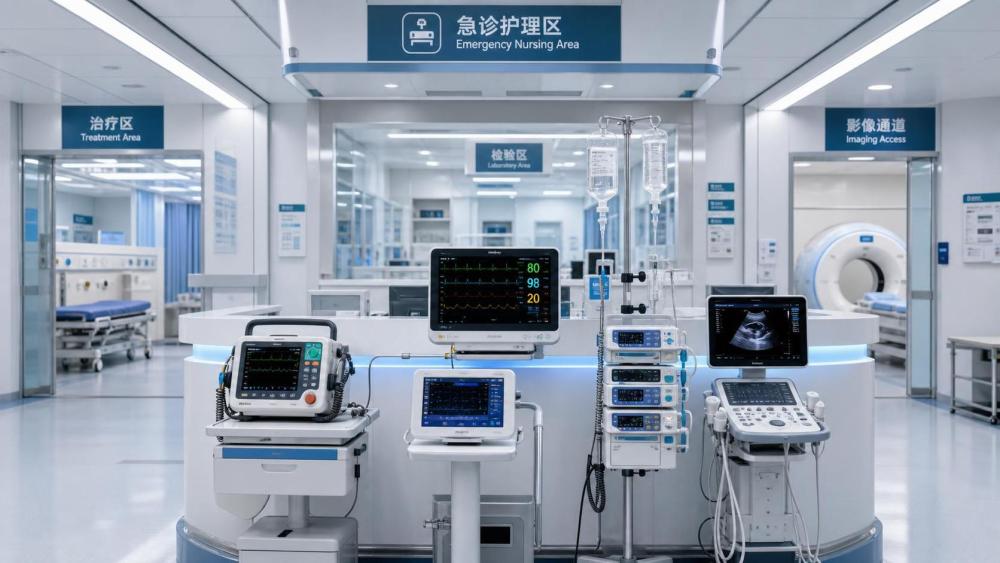
Equipment readiness is a common example. A defibrillator, patient monitor, infusion pump, ventilator, portable suction unit, transport monitor, or point-of-care device may technically be present in the department but unavailable in practice because it is being cleaned, charging, awaiting maintenance, missing accessories, or located in another area. A workflow should define not only how many devices are needed, but also where they are stored, who checks them, how accessories are replenished, and what happens when a device is removed from service.
Standardized room setups are especially useful in high-acuity zones. When commonly required items are in the same location and replenished through a clear process, staff spend less time searching and are less likely to substitute inappropriate equipment under pressure. Standardization should still allow for local clinical needs. A resuscitation area, rapid-assessment space, pediatric room, and isolation room do not require identical setups.
Consumables deserve the same attention as capital equipment. A monitor cannot support rapid assessment without compatible leads, sensors, cuffs, batteries, printer supplies where needed, and properly configured patient identification processes. An infusion pump does not shorten treatment time if the correct administration set is missing. Procurement decisions should account for these operational dependencies rather than evaluating a device as an isolated purchase.
Use monitoring to support decisions, not create alarm noise
Patient monitoring can reduce delay when it gives the care team timely, usable information. It can also slow work when devices generate frequent non-actionable alarms, settings vary between areas, or staff must repeatedly verify data that should already be visible.
Monitoring practices should match patient acuity and the intended care pathway. Continuous monitoring may be appropriate for patients who need close observation, while repeated manual checks may suit stable patients awaiting a defined step. Applying the same monitoring approach to every patient can overload staff and make meaningful deterioration harder to detect.
Alarm management is part of workflow design. Alarm limits, escalation routes, and response responsibilities should be understood before a busy shift begins. Silencing or disabling alarms to reduce noise is not a workflow solution; it can hide a safety problem. The better approach is to address poor electrode contact, inappropriate default settings, device placement, unnecessary duplicate alerts, and unclear response roles.
Where monitoring systems integrate with clinical documentation or centralized viewing, the implementation should be tested against actual tasks. The question is not whether a system has an integration feature. It is whether the integration reduces manual transcription, helps staff locate the correct patient, and makes important changes easier to act on without creating extra logins or duplicate entries.
Bring diagnostics closer to the clinical decision
Diagnostic turnaround is often discussed as a laboratory or imaging issue, but emergency delays usually involve the entire chain: ordering, patient preparation, specimen collection, labeling, transport, analysis, result verification, result review, and the decision that follows.
For time-sensitive pathways, define which tests or imaging studies must happen early and which can wait until the initial clinical assessment is complete. Ordering every possible test “just in case” may overwhelm collection, laboratory, or imaging capacity and make it harder to prioritize patients who need urgent answers. Focused early diagnostics work best when linked to an explicit decision: rule out an immediate threat, determine the treatment area, confirm readiness for a procedure, or decide whether admission is likely.
Point-of-care testing can shorten the path to a decision when it is placed near the clinical team, has reliable quality processes, and staff are trained to operate it correctly. It is not automatically the right answer for every test. If cartridges, controls, maintenance, connectivity, or operator competence are poorly managed, the apparent speed advantage can disappear. The same principle applies to portable imaging: it is valuable when moving the equipment is faster and safer than moving the patient, not simply because it is mobile.
Results also need a visible owner. A completed test does not improve care until someone recognizes the result, interprets it in context, and records or communicates the next action. Workflow dashboards can help identify pending results, but a reliable escalation rule is still needed for results that are delayed, critical, or likely to change disposition.
Design handoffs as clinical work
Handoffs are often treated as administrative moments between more important tasks. In emergency care, they are clinical events where delays and errors can multiply. Shift change, transfer from triage to treatment, movement to imaging, referral to a specialty team, admission, and discharge all require information to travel with the patient.
A concise handoff should make the next person immediately aware of the working diagnosis, current risks, interventions already completed, pending tasks, pending results, equipment needs, and the reason for escalation or transfer. It should not require the receiver to reconstruct the patient story from multiple screens, paper notes, or verbal fragments.
Structured handoff tools are useful when they reduce omissions without becoming another long form to complete. The best format is usually one that reflects the actual decisions the receiving team must make. For a transfer to imaging, stability, oxygen or monitoring requirements, lines and infusions, infection precautions, and return destination may matter most. For an inpatient handoff, treatment response, pending results, medication timing, and expected deterioration risks may be more relevant.
Protect flow during bed and capacity pressure
Emergency departments cannot solve hospital-wide capacity constraints alone, but they can prevent capacity pressure from producing avoidable internal delays. A patient awaiting an inpatient bed should have a clear care owner, monitoring plan, medication plan, and reassessment schedule. Otherwise, boarding patients can consume attention in an unstructured way while newly arriving patients wait longer for assessment.
Separate pathways can help when patient groups have different needs and expected lengths of care. A rapid-treatment pathway may be appropriate for lower-complexity conditions with a defined plan, while an observation pathway may suit patients who need serial assessment rather than immediate admission. These pathways should be based on clinical appropriateness and available support, not merely on a desire to move patients out of the main area.
Physical layout matters here. When staff repeatedly cross the department to obtain supplies, find a monitor, locate a wheelchair, or identify an available treatment space, the layout is contributing to delay. Small changes in storage, signage, room designation, and equipment location can improve flow without a major rebuild.
Choose technology by workflow fit
When hospitals evaluate emergency care equipment or digital systems, the first question should be: which delay does this solve, and what new work will it create? A device with attractive specifications may still be a poor fit if cleaning is slow, training requirements are heavy, accessories are difficult to source, battery runtime does not fit transport practice, or service response is not aligned with the department’s reliance on the equipment.
For patient monitoring, consider visibility of critical information, alarm configuration, ease of moving a patient between care areas, accessory compatibility, cleaning requirements, and integration with existing systems. For point-of-care diagnostics, assess the full operating cycle: sample type, operator steps, identification, quality controls, maintenance, result transmission, and consumable continuity. For mobile emergency equipment, consider maneuverability, storage footprint, charging, infection-control workflow, and whether the device can be checked quickly at the start of a shift.
Global MedTech & Healthcare Intelligence Hub (MTHH) can support earlier-stage evaluation by organizing information across emergency department solutions, monitoring systems, diagnostic equipment, clinical engineering requirements, consumables, and service considerations. That comparison is most useful before procurement discussions, when the care pathway and operating conditions can still shape the specification.
Improve one delay at a time, then test the whole pathway
Large workflow redesigns can fail when too many changes are introduced at once. Start with a delay that is frequent, visible, and within the department’s ability to influence. It may be delayed room turnover, missing transport monitoring, unclear ownership of pending results, or repeated searching for basic supplies.
Define the expected sequence, assign ownership, prepare the required equipment and information, and observe the process across several shifts. Ask staff where they need to stop, wait, duplicate work, or seek clarification. Their answers often reveal the gap between the written process and the operational reality.
Then test whether the change improves the entire pathway rather than simply moving work elsewhere. Faster triage has limited value if it creates a longer queue for assessment. More rapid testing does not help if results wait unreviewed. A successful emergency care workflow makes the next clinically appropriate action easier to perform, easier to see, and harder to miss.
Have questions about the global trade trends discussed here, or planning your expansion and supply chain strategy? Leave a message below and let the trade experts at MTHH guide you.
We respect your privacy. Your information is strictly confidential.
Related News
- Hong Kong Outlines Medical Device Legislation and Plans for Statutory RegulatorNov 14, 2026Hong Kong medical device legislation could reshape regulatory oversight. Explore the proposed regulator and what businesses should monitor.
- AAMI Issues TIR115 Guidance on Public Cloud Use in Medical DevicesNov 13, 2026AAMI TIR115:2026 guides public cloud use in medical devices. Explore its focus on risk management, supplier assessment and device boundaries.
- How are critical care devices regulated in the United States?Nov 12, 2026Critical care devices face FDA requirements based on intended use and risk. Explore classifications, marketing pathways, and practical compliance checks.
- Hong Kong Drafts Medical Device Bill to Establish Statutory OversightNov 12, 2026Hong Kong's Medical Devices Bill could introduce risk-based statutory oversight. Discover what the proposed framework may mean for suppliers.