
How Preventive Maintenance Supports Medical Equipment Compliance Audits
How Preventive Maintenance Supports Medical Equipment Compliance Audits
For quality control and safety teams, compliance audits rarely fail because a hospital forgot that maintenance matters. They fail because maintenance exists in fragments: a service sticker on the device, a checklist in biomedical engineering, a calibration report in another folder, and no clean way to prove that the equipment was maintained according to policy, manufacturer instructions, and risk level. That gap is exactly where preventive maintenance for medical equipment compliance becomes more than a technical routine. It becomes auditable evidence.
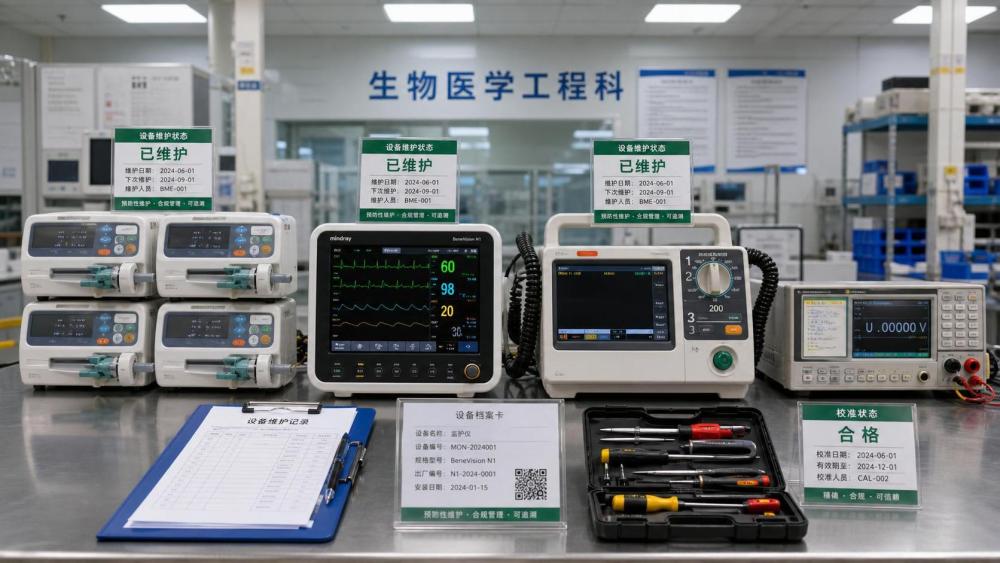
In healthcare, preventive maintenance is often misunderstood as a scheduled technical service meant to keep devices running. That is only part of the picture. In an audit context, preventive maintenance is a controlled process that links asset identification, maintenance intervals, functional checks, replacement of wear components where applicable, test results, documentation, and follow-up actions. Auditors are not only asking whether a patient monitor, defibrillator, sterilizer, or infusion pump was inspected. They want to see whether the organization can show a consistent maintenance logic and demonstrate that equipment used in patient care remains safe, accurate, and fit for purpose.
This distinction matters because medical equipment sits inside several overlapping compliance expectations. The exact framework varies by country and facility type, but common reference points include manufacturer instructions for use, internal hospital maintenance policies, accreditation standards, quality management procedures, electrical safety practices, metrology controls for devices with measurement functions, and documented risk management. A compliance audit usually tests whether those pieces work together in real operations, not whether each document exists in isolation.
Why audits focus on maintenance records so closely
Auditors know that maintenance records reveal operational discipline faster than many other documents. A procurement file can be complete and a policy manual can look polished, but if high-risk devices show overdue preventive maintenance, missing performance verification, or unclear service responsibility, the organization appears exposed. That exposure is not theoretical. For devices involved in diagnosis, monitoring, life support, sterilization, or medication delivery, maintenance status can directly affect patient safety and clinical reliability.
A good preventive maintenance program supports audits because it answers several practical questions without forcing the auditor to guess:
- Which devices are in scope, and where are they located?
- How are maintenance intervals determined: manufacturer recommendation, risk classification, usage intensity, or regulatory requirement?
- What work was actually performed during each maintenance event?
- Were test instruments calibrated and suitable for the checks performed?
- What happened when a device failed inspection or missed its schedule?
- Who reviewed the records, and how was the device returned to service?
When those answers are easy to trace, the audit discussion shifts. Instead of debating whether the hospital has control over its equipment base, the conversation moves toward how mature that control is.
Maintenance is not the same as repair
One recurring audit problem is the assumption that frequent repairs prove strong maintenance. They do not. Corrective service addresses failure after the fact. Preventive maintenance is intended to reduce the chance of hidden degradation going unnoticed. For compliance purposes, the difference is important. A ventilator that was repaired promptly after a malfunction still raises an audit question if its prior inspections were overdue or undocumented. A repaired device may be usable again, but the organization still has to show that the failure was not enabled by weak control of the maintenance schedule.
The same issue appears with devices that continue to function despite drifting performance. Laboratory analyzers, imaging systems, infusion equipment, and patient monitoring systems may not fail dramatically at first. They may continue operating while accuracy, alarm performance, battery condition, sensor response, or output consistency degrades. That is why preventive maintenance and related verification steps matter in audits: they demonstrate that the hospital is not waiting for obvious breakdown before acting.
What auditors usually expect to see
The strongest audit-ready maintenance systems are not necessarily the most complex. They are the ones with clear traceability. In practice, auditors often look for a chain of evidence running from asset registration to maintenance execution to review and release. For example, each device should be uniquely identifiable, linked to its model, serial number, department, risk category, maintenance frequency, and service history. If an interval changes, the basis for that change should also be visible.
For quality and safety teams, the maintenance record itself needs to show more than a date and signature. A useful record normally includes the procedure used, the checks completed, parts replaced if relevant, test outcomes, any deficiencies found, the corrective action raised, and the final status of the equipment. For measurement-related or safety-related devices, supporting evidence may include electrical safety tests, calibration certificates, performance verification, alarm checks, leakage tests, or functional acceptance after service, depending on the equipment type and local requirements.
That does not mean every device should be maintained in the same way. An MRI system, a hospital bed, and a centrifuge do not carry the same risk profile or service complexity. Auditors generally understand this. What they want is a justified maintenance strategy rather than a uniform one. If the organization can explain why life-support devices are monitored more tightly than low-risk support equipment, and can show that this approach is consistently applied, the maintenance program looks controlled rather than arbitrary.
Where compliance problems usually start
The most common weaknesses are less technical than procedural. Equipment inventories are incomplete. Devices move between departments without location updates. Loan units or backup units enter service without full documentation. Third-party service providers perform maintenance, but the hospital cannot quickly retrieve the full service report. Test equipment used by in-house engineers is itself overdue for calibration. A department keeps paper records while the central engineering team relies on a computerized maintenance management system, and the two never fully reconcile.
Another weak point is overreliance on maintenance labels. A sticker showing a next due date may help on the floor, but it is not enough for compliance. Auditors need the underlying record, the defined procedure, and proof that exceptions were handled properly. A missed inspection with no documented risk decision is a different situation from a deferred inspection that was approved, justified, and tracked.
Software-dependent equipment creates an additional layer. Preventive maintenance for certain devices is no longer only about physical components. It may include software version control, cybersecurity-related patch coordination, network configuration checks, backup verification, and validation that updates did not alter intended performance. Hospitals sometimes separate these activities between biomedical engineering and IT, but audits often expose the boundary problem: everyone assumes the other team has documented it.
A useful way to judge whether a maintenance program is audit-ready
A practical test is to pick one device at random and ask for its full compliance story. Not a summary, the full story. Can the team show when the device entered service, whether acceptance testing was completed, what maintenance interval applies, when the last preventive maintenance occurred, what checks were performed, whether any issues were found, how those issues were closed, and whether the device is currently cleared for use? If assembling that story takes too long, depends on one person’s memory, or requires pulling records from multiple unconnected systems, the audit risk is already visible.
The role of risk classification
Not every maintenance gap carries the same compliance weight. A delayed inspection on a low-risk accessory is different from a missed preventive maintenance event on a defibrillator, anesthesia machine, or sterilization system. Mature programs reflect that reality through risk classification. The point is not to create more paperwork. It is to align maintenance effort with potential impact on patients, users, and clinical decisions.
This is also where quality control and clinical engineering need to stay closely connected. The engineering team may understand technical failure modes in detail, while quality or safety teams understand how auditors interpret system control, nonconformity, and documented evidence. Preventive maintenance becomes stronger when both views shape the process. Technical work without compliance traceability is hard to defend. Documentation without technical relevance is easy to challenge.
What preventive maintenance really proves
The value of preventive maintenance in a compliance audit is not that it proves equipment never fails. No credible auditor expects that. What it proves is that the organization has a disciplined method for anticipating failure, detecting hidden deterioration, controlling maintenance intervals, and documenting decisions when something does not go as planned. That is a much stronger compliance position than simply showing that service vendors were called when equipment stopped working.
For organizations involved in procurement, installation, and long-term equipment management, this has a wider implication. The audit-readiness of a device does not begin at inspection day. It begins when the equipment enters the asset register, when service obligations are defined, when spare parts and consumables support is understood, and when responsibilities between manufacturer, distributor, third-party service provider, and hospital team are made explicit. Preventive maintenance for medical equipment compliance is therefore less about one maintenance event and more about whether the full equipment lifecycle can stand up to scrutiny.
A practical standard for judging the system is simple: if an auditor selects any critical device and your organization can show a complete, technically meaningful, and current maintenance record without reconstruction or guesswork, the program is doing its job. If that same request triggers a search across spreadsheets, emails, stickers, and vendor promises, the issue is not just documentation. It is control.
Have questions about the global trade trends discussed here, or planning your expansion and supply chain strategy? Leave a message below and let the trade experts at MTHH guide you.
We respect your privacy. Your information is strictly confidential.
Related News
- Hong Kong Outlines Medical Device Legislation and Plans for Statutory RegulatorNov 14, 2026Hong Kong medical device legislation could reshape regulatory oversight. Explore the proposed regulator and what businesses should monitor.
- AAMI Issues TIR115 Guidance on Public Cloud Use in Medical DevicesNov 13, 2026AAMI TIR115:2026 guides public cloud use in medical devices. Explore its focus on risk management, supplier assessment and device boundaries.
- How are critical care devices regulated in the United States?Nov 12, 2026Critical care devices face FDA requirements based on intended use and risk. Explore classifications, marketing pathways, and practical compliance checks.
- Hong Kong Drafts Medical Device Bill to Establish Statutory OversightNov 12, 2026Hong Kong's Medical Devices Bill could introduce risk-based statutory oversight. Discover what the proposed framework may mean for suppliers.