
Hospital Cleanroom Validation: Key Standards, Tests, and Failure Risks
What hospital cleanroom validation actually proves
Hospital cleanroom validation is often misunderstood as a one-time certification exercise. In practice, it is closer to documented proof that a controlled clinical environment can consistently perform as intended under defined operating conditions. That distinction matters. A room may look clean, pass a visual inspection, and still fail to maintain the environmental control needed for sterile compounding, CSSD support areas, operating suites, isolation support spaces, or specialized laboratory functions.
Validation is not only about airborne particle counts. It also asks whether airflow direction is correct, pressure cascades are stable, recovery time is acceptable after disturbance, filtration is intact, temperature and humidity stay within limits, and the room still performs when people, equipment, and routine hospital activity are introduced. For quality and safety managers, that is the practical meaning of hospital cleanroom validation: evidence that engineering controls and operational controls are aligned, repeatable, and defensible.
This is why validation sits between design intent and day-to-day use. Designers may specify air changes, HEPA filtration, and room pressurization. Contractors may install everything correctly. Yet the hospital still needs objective confirmation that the completed room behaves properly in its real configuration, with installed equipment, actual door usage, and defined cleaning and gowning procedures. Without that link, compliance documents can exist while contamination risk remains poorly controlled.
Standards are not interchangeable
One of the most common mistakes is treating all cleanroom standards as if they serve the same purpose. They do not. ISO 14644 is the core reference family for cleanrooms and associated controlled environments, especially when discussing airborne particle classification, test methods, and ongoing monitoring expectations. In hospital projects, ISO terminology is frequently used because it gives a shared technical language for design firms, validation contractors, biomedical teams, and compliance reviewers.
But hospital environments are rarely governed by ISO alone. Depending on the room function and country, validation may need to align with healthcare facility guidance, infection prevention requirements, pharmacy compounding rules, ventilation standards, and national building or health regulations. For sterile compounding, teams often work within frameworks tied to USP chapters in the United States, especially where nonhazardous or hazardous drug preparation is involved. For HVAC design in healthcare facilities, ASHRAE guidance is also highly relevant. In Europe and other regions, local health authority requirements may drive acceptance criteria or documentation structure.
That is why asking “Is the room ISO certified?” is not enough. A more useful question is: which standard defines classification, which standard defines clinical use conditions, and which authority will review the records? A room can meet one framework and still fall short for its intended hospital use if the wrong acceptance logic was applied.
The tests that matter most in hospital settings
Validation testing usually combines several layers of evidence rather than a single pass-fail number. Airborne particle count testing remains the most recognized element because it supports room classification. Even so, particle data only tells part of the story. A room may classify correctly at rest yet become unstable in operation if airflow patterns are weak or staff movement disrupts the critical zone.
Pressure differential testing is especially important in hospitals because many risk controls depend on directional airflow between adjacent spaces. Positive pressure may be required to protect a sterile process from contamination entering the room, while negative pressure may be needed where containment is the priority. A pressure cascade that drifts, reverses, or collapses when doors open is not a minor defect. It can directly compromise infection control strategy.
Airflow visualization, often performed with smoke studies or similar methods, is frequently undervalued until a failure occurs. This test makes invisible performance visible. It helps confirm whether first air reaches the critical work area, whether turbulence forms around large equipment, whether return grilles pull contaminants across the protected zone, and whether operators themselves block clean airflow. In operating theatres, sterile compounding areas, or device preparation rooms, these patterns can matter as much as the classification result.
Filter integrity testing is another core element. HEPA filters are often assumed to be reliable once installed, but installation damage, poor sealing, and frame leakage do occur. Integrity testing checks whether the filtration barrier performs across the installed system, not just in theory on a product datasheet.
Additional tests commonly include air volume or velocity measurement, airflow balancing, temperature and humidity verification, recovery testing after a contamination event or disturbance, and in some projects, microbiological monitoring. The exact package depends on room use, local regulation, and the hospital’s risk profile.
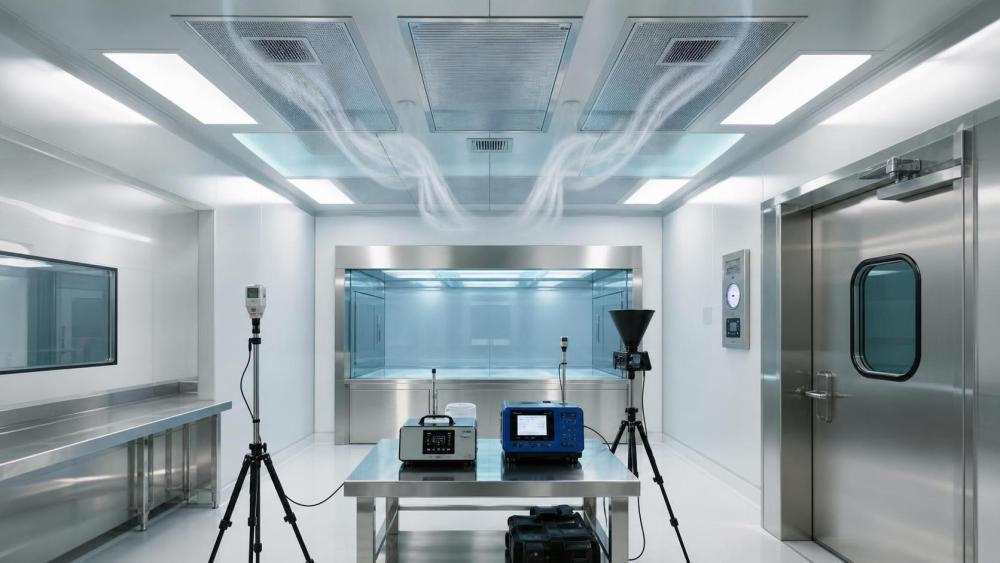
A useful way to read validation scope
Where failures usually begin
In many hospital projects, cleanroom failure does not start with a dramatic equipment breakdown. It starts with small mismatches between intended use and actual operation. A room classified correctly for a compounding process may later receive additional cabinets, carts, refrigerators, pass-throughs, or monitoring devices that change airflow patterns. A maintenance team may replace a filter or rebalance air handling without understanding how tight the original validation margins were. Clinical users may adopt new work practices that increase door traffic or overload the room.
Another frequent failure point is treating commissioning and validation as the same thing. Commissioning shows that building systems were installed and function generally as designed. Validation goes further by confirming that the room supports the controlled process under accepted criteria. If a hospital relies only on HVAC startup reports, it may miss operational weaknesses that become visible only under process conditions.
Documentation gaps are also more serious than they appear. When deviation handling, calibration records, requalification intervals, or change control are weak, the hospital may not be able to prove ongoing control even if the room is physically sound. During an audit, missing traceability can be almost as damaging as a failed test result because it raises doubt about the reliability of the entire control system.
At-rest performance is not the same as in-operation control
This point deserves emphasis because it creates repeated confusion. Validation reports often distinguish between “as built,” “at rest,” and “operational” or “in operation” conditions. Those terms are not administrative detail. They describe different levels of challenge to the room. A space may meet particle limits when empty and static, then behave very differently once personnel enter, supplies are unwrapped, equipment heats up, and doors cycle through normal workflows.
For hospital safety managers, this means the cleanroom should be judged against the mode that actually reflects its risk. If the room protects a process performed by people, operational evidence matters. If the acceptance package only demonstrates favorable empty-room results, decision-makers should read that as incomplete context rather than complete assurance.
How requalification should be viewed
Hospital cleanroom validation is not finished when the initial report is signed. Requalification is part of maintaining control, especially after repairs, layout changes, filter replacement, HVAC modification, unexplained environmental excursions, or a shift in room use. Some standards and local regulations set periodic expectations, but the timing should also reflect risk. High-sensitivity processes and critical pharmacy environments generally justify a tighter review discipline than low-risk support spaces.
The practical question is not simply “When does the certificate expire?” It is “What changes could have invalidated the original state?” That is a more mature way to manage cleanrooms in hospitals, where facilities evolve continuously and engineering changes are common.
What quality and safety managers should look for in reports
A credible validation report should make the testing basis clear: room identification, intended use, test condition, applicable standards, equipment used, calibration status, sampling logic, acceptance criteria, deviations, and final conclusion. Vague summaries are a warning sign. So are reports that present pass results without showing the condition under which those results were obtained.
It is also worth checking whether the validation package reflects the room as it is actually used. Drawings, airflow diagrams, pressure relationships, and room layouts should match reality. If the report describes a theoretical configuration that no longer exists, the hospital is relying on historical paperwork rather than current control evidence.
In procurement or project handover, this becomes a commercial as well as technical issue. Hospitals should not evaluate a cleanroom contractor or system supplier only by installation completion. They should examine whether the delivered documentation supports future audits, maintenance decisions, retraining, and requalification. A room without usable records is harder to defend and harder to manage.
A sound validation mindset is risk-based, not checklist-based
The strongest cleanroom programs in hospitals are not the ones with the thickest binders. They are the ones where the validation approach is tied to patient risk, process sensitivity, and actual room behavior. That means understanding which tests are foundational, which standards apply to the specific healthcare function, and where routine operations are most likely to erode control.
For teams reviewing hospital cleanroom validation, the real objective is not to collect a compliance artifact. It is to confirm that the room can still protect the process it was built for, under the conditions in which staff really work. When that is the lens, standards, test results, and failure risks become easier to interpret and harder to oversimplify.
Have questions about the global trade trends discussed here, or planning your expansion and supply chain strategy? Leave a message below and let the trade experts at MTHH guide you.
We respect your privacy. Your information is strictly confidential.
Related News
- Hong Kong Outlines Medical Device Legislation and Plans for Statutory RegulatorNov 14, 2026Hong Kong medical device legislation could reshape regulatory oversight. Explore the proposed regulator and what businesses should monitor.
- AAMI Issues TIR115 Guidance on Public Cloud Use in Medical DevicesNov 13, 2026AAMI TIR115:2026 guides public cloud use in medical devices. Explore its focus on risk management, supplier assessment and device boundaries.
- How are critical care devices regulated in the United States?Nov 12, 2026Critical care devices face FDA requirements based on intended use and risk. Explore classifications, marketing pathways, and practical compliance checks.
- Hong Kong Drafts Medical Device Bill to Establish Statutory OversightNov 12, 2026Hong Kong's Medical Devices Bill could introduce risk-based statutory oversight. Discover what the proposed framework may mean for suppliers.