
Healthcare Supply Chain Strategy: Cost Risks and Resilience Priorities in 2026
In 2026, healthcare supply chain strategy has moved beyond unit pricing and contract timing. It now sits closer to clinical continuity, capital planning, compliance readiness, and the ability to keep essential services running under pressure.
That shift matters because healthcare delivery depends on linked flows of devices, consumables, software support, spare parts, documentation, and trained service capacity. When one link weakens, the cost impact is rarely limited to purchasing.
For hospitals, distributors, manufacturers, and project planners, a practical healthcare supply chain strategy now means knowing where cost risk hides, which categories are fragile, and how resilience can be built without overbuying.
Why the conversation has changed
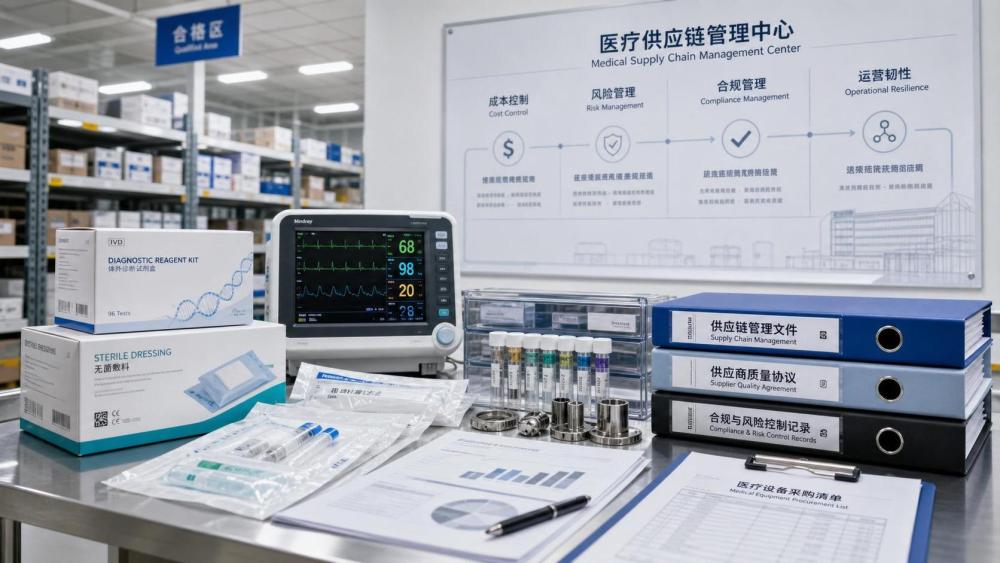
Healthcare supply chains are dealing with a tougher operating environment. Freight volatility still matters, but it is no longer the only issue shaping cost and access.
Regulatory requirements are expanding across markets. Product registrations, labeling rules, traceability expectations, and post-market obligations can slow sourcing decisions or narrow the approved supplier pool.
At the same time, many healthcare categories remain dependent on concentrated manufacturing bases. A disruption in one region can affect reagents, imaging components, sensors, sterile packaging, and service parts at once.
This is why healthcare supply chain strategy is now discussed alongside resilience. Cost control still matters, but service continuity has become an equal measure of performance.
What healthcare supply chain strategy really includes
A mature healthcare supply chain strategy covers more than sourcing. It connects category planning, supplier risk review, installed-base support, clinical usage patterns, maintenance planning, and demand forecasting.
In healthcare, the purchased item is often only one part of the operating requirement. A diagnostic analyzer also needs reagents, calibration materials, uptime support, software compatibility, and stable documentation.
The same is true for patient monitoring, sterilization systems, imaging platforms, infusion equipment, and emergency care devices. Initial procurement can look competitive while lifecycle exposure remains high.
That is why effective healthcare supply chain strategy should be built around total operating continuity, not just purchase price variance.
The hidden layers of cost risk
Some costs are visible during tendering. Others appear later, when equipment is installed, scaled, maintained, or audited.
These issues often sit outside a narrow procurement lens. Yet they strongly influence the real cost of ownership.
Where the pressure is highest in 2026
Not every healthcare category carries the same supply risk. High dependency segments deserve closer attention because they combine technical complexity with limited substitution options.
Imaging and capital equipment
CT, MRI, ultrasound, digital X-ray, and C-arm systems rely on specialized components, site preparation, and long service commitments. A delayed detector, tube, or software patch can affect throughput for months.
Here, healthcare supply chain strategy should consider room readiness, parts availability, uptime guarantees, and local technical support before comparing headline prices.
IVD and laboratory operations
Laboratory systems are especially exposed to reagent concentration risk. Throughput may look strong on paper, but continuity depends on lot stability, calibration needs, quality controls, and supply predictability.
A resilient healthcare supply chain strategy in diagnostics should test what happens if one reagent source fails, transport slows, or local registration changes interrupt replenishment.
Patient care and hospital infrastructure
Ventilators, monitors, infusion pumps, sterilizers, beds, nurse call systems, and medical gas infrastructure have direct operational consequences. Downtime affects staff workload, patient flow, and safety protocols immediately.
In these categories, resilience depends on service response time, replacement access, consumables supply, and technician training as much as on the device itself.
How structured information improves decisions
Healthcare supply chain strategy becomes stronger when decision-making is based on organized technical and commercial information rather than isolated quotes.
This is where platforms such as Global MedTech & Healthcare Intelligence Hub matter. Clear category-level analysis helps compare equipment performance, service needs, consumable dependency, compliance readiness, and lifecycle exposure.
That approach is particularly useful in healthcare because procurement choices must align with clinical use, patient safety, maintenance capacity, installation conditions, and software support.
It also improves cross-functional discussions. When cost, engineering, operations, and market access teams look at the same structured data, trade-offs become easier to evaluate.
Practical priorities for a stronger 2026 approach
A workable healthcare supply chain strategy does not require rebuilding every supplier relationship. It starts with sharper prioritization.
- Segment categories by clinical criticality, replacement difficulty, and consumable dependency.
- Map single-source exposure across devices, parts, reagents, accessories, and software service.
- Review contracts for uptime terms, lead-time commitments, training scope, and documentation support.
- Compare price offers against total operating cost, including calibration, maintenance, and downtime risk.
- Check whether local service infrastructure can support the installed base under stress conditions.
- Track regulatory changes that may affect labeling, registration, import timing, or post-market obligations.
These steps help separate routine purchasing issues from strategic resilience gaps. That distinction is important because not every problem needs the same response.
Questions worth asking before the next sourcing cycle
Several questions can reveal whether a healthcare supply chain strategy is robust or only cost-focused.
- Can a key system continue operating if one supplier misses delivery for six weeks?
- Which product lines depend on proprietary consumables or software access?
- How much downtime cost is created by delayed field service or missing parts?
- Are technical documents and compliance records complete for target markets?
- Does the chosen product fit workflow, staffing, and maintenance reality at the site level?
From cost control to operational resilience
The most effective healthcare supply chain strategy in 2026 will not be the cheapest on paper. It will be the one that protects continuity while keeping costs predictable across the equipment lifecycle.
That means linking sourcing choices to clinical performance, service infrastructure, compliance exposure, and long-term support capacity. In healthcare, resilience is rarely built through inventory alone.
A better next step is to review high-impact categories first, especially where downtime, reagent dependence, or technical support limitations could disrupt care delivery. From there, supplier comparisons become more meaningful, and investment decisions become easier to defend.
For organizations navigating medical devices, diagnostics, hospital infrastructure, and clinical technology planning, the value lies in building a healthcare supply chain strategy that can absorb shocks without losing operational control.
Have questions about the global trade trends discussed here, or planning your expansion and supply chain strategy? Leave a message below and let the trade experts at MTHH guide you.
We respect your privacy. Your information is strictly confidential.
Related News
- Hong Kong Outlines Medical Device Legislation and Plans for Statutory RegulatorNov 14, 2026Hong Kong medical device legislation could reshape regulatory oversight. Explore the proposed regulator and what businesses should monitor.
- AAMI Issues TIR115 Guidance on Public Cloud Use in Medical DevicesNov 13, 2026AAMI TIR115:2026 guides public cloud use in medical devices. Explore its focus on risk management, supplier assessment and device boundaries.
- How are critical care devices regulated in the United States?Nov 12, 2026Critical care devices face FDA requirements based on intended use and risk. Explore classifications, marketing pathways, and practical compliance checks.
- Hong Kong Drafts Medical Device Bill to Establish Statutory OversightNov 12, 2026Hong Kong's Medical Devices Bill could introduce risk-based statutory oversight. Discover what the proposed framework may mean for suppliers.