
China Tightens Medical Device Export Compliance Rules for IVD and Imaging Files
On 2026-08-15, the NMPA issued a notice on strengthening overseas registration support and compliance coordination for exported medical devices. The signal is clear: for IVD reagents and medical imaging equipment headed to the EU, US, Southeast Asia, and Middle East markets, the domestic registration dossier, instructions, labels, and clinical evaluation materials must align in substance with the versions used for overseas registration or filing, and exports may face pre-shipment compliance cross-checks. For exporters, distributors, certification teams, and supply chain service providers, this is worth close attention because it directly affects clearance, CE/FDA linkage, and downstream market access.
What the notice confirms
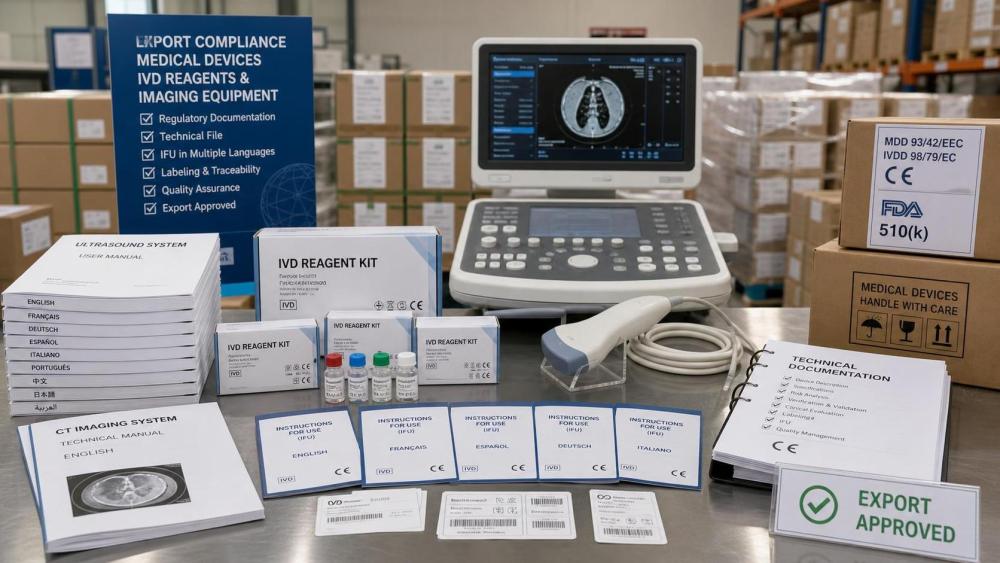
The notice was released by the NMPA on 2026-08-15. It states that, from 2026-10-01, all IVD reagents and medical imaging devices intended for export to the EU, the US, Southeast Asia, and Middle East markets fall under a requirement that the technical documents, instructions, labels, and clinical evaluation materials attached to the domestic registration certificate must remain substantively consistent with the versions used for registration or filing in the target market. The same notice also introduces pre-export compliance comparison spot checks.
Where the operational impact is likely to land
Exporters and registration teams will need tighter document alignment
Analysis suggests the most immediate pressure will fall on exporters that manage parallel domestic and overseas filings. If the domestic dossier and the target-market file diverge in wording, scope, or presentation, the likely friction point is no longer limited to internal review; it may also appear at export review, clearance, or customer onboarding. The practical focus shifts to whether the same product can still move through multiple compliance tracks without document drift.
Certification and testing workflows may need earlier synchronization
For CE and FDA-related coordination, the notice implies that certification support work cannot be treated as a separate late-stage exercise. What deserves closer attention is whether technical documents, labels, and clinical evaluation materials are being maintained as a single controlled set across jurisdictions. That affects certification consultants, testing bodies, and regulatory affairs teams that prepare filings, compare versions, or support market-specific submissions.
Importers and distributors may see more pressure at customs and onboarding
Because the notice explicitly links the requirement to export compliance checks, overseas importers and local distributors may face additional scrutiny when receiving goods whose supporting files do not match the destination-market registration set. At this stage, it is more appropriate to understand this as a trade-and-compliance coordination issue rather than a packaging issue alone. Clearance timing, dossier review, and distributor acceptance may all be affected if file consistency is weak.
Imaging software and AI-assisted modules are now part of the same review logic
The scope named in the notice includes ultrasound, X-ray, and CT supporting software as well as AI-assisted diagnostic modules. That means the compliance burden is not limited to hardware specifications. From an industry perspective, software release management, algorithm documentation, labeling, and clinical claims may need the same version control discipline as the main device file.
What companies should check now
Review version control across domestic and overseas files
Companies should verify whether the domestic registration certificate dossier and the target-market registration or filing package are aligned in substance. The key items are technical documents, instructions, labels, and clinical evaluation materials. Any mismatch should be treated as a compliance gap that needs review, not as a minor wording difference.
Map which product lines fall inside the stated scope
Priority should be given to IVD reagents and medical imaging equipment intended for the EU, the US, Southeast Asia, and Middle East markets. Within imaging, the notice explicitly names ultrasound, X-ray, CT supporting software, and AI-assisted diagnostic modules. Companies should confirm which SKUs, software versions, and documentation sets are exposed to the new comparison requirement.
Prepare for pre-export spot checks rather than after-the-fact correction
The notice points to pre-shipment compliance comparison checks, so a reactive approach will be costly. Firms should assess whether their export release process can produce a consistent file pack on demand, including translation control, label history, change logs, and clinical evaluation traceability. This matters especially where multiple parties manage parts of the dossier.
Recheck vendor and service-provider responsibilities
Where document preparation, translation, testing, or regulatory support is outsourced, companies should confirm who owns version control and who signs off on cross-market consistency. In practice, the new requirement raises the value of disciplined handoffs between manufacturers, consultants, and logistics partners.
How to read this signal
This announcement is best read as a compliance execution signal rather than a purely descriptive policy update. It does not just restate a filing principle; it ties domestic registration materials to target-market consistency and adds export-side checks. That is a meaningful operational shift for firms that have relied on separate document tracks for different destinations.
At the same time, the market will still need to watch how the comparison standard is applied in practice. The notice says “substantive consistency,” which leaves room for execution interpretation. The real question for industry participants is how strictly the comparison will be handled across different product types, software modules, translations, and local market formats.
The broader takeaway is straightforward: this is not a signal to wait passively. It is a prompt to tighten file governance now, because the compliance burden is moving closer to the export gate.
What this means for the market
For the sector, the main implication is that registration, export, and destination-market access can no longer be managed as separate workstreams with loose document alignment. The notice pushes the industry toward more synchronized dossier control, especially for products where software, clinical claims, and labeling are central to approval and distribution. The most prudent reading is that this is an implementation and enforcement signal that should be handled as active compliance preparation, while the finer execution details remain under observation.
Source basis and follow-up
This article is based on the user-provided title, event date, and summary, and is written for an industry news format. The relevant source types for this kind of event would normally include an official NMPA notice, related regulatory announcements, customs or trade compliance updates, and industry association commentary. A specific official source link was not provided in the input, so the exact public document should continue to be verified. Further attention should remain on detailed implementation guidance, certification practice, export review handling, and industry feedback after 2026-10-01.
Have questions about the global trade trends discussed here, or planning your expansion and supply chain strategy? Leave a message below and let the trade experts at MTHH guide you.
We respect your privacy. Your information is strictly confidential.
Related News
- AAMI Issues TIR115 Guidance on Public Cloud Use in Medical DevicesNov 13, 2026AAMI TIR115:2026 guides public cloud use in medical devices. Explore its focus on risk management, supplier assessment and device boundaries.
- How are critical care devices regulated in the United States?Nov 12, 2026Critical care devices face FDA requirements based on intended use and risk. Explore classifications, marketing pathways, and practical compliance checks.
- Hong Kong Drafts Medical Device Bill to Establish Statutory OversightNov 12, 2026Hong Kong's Medical Devices Bill could introduce risk-based statutory oversight. Discover what the proposed framework may mean for suppliers.
- How does health technology assessment influence US coverage decisions?Nov 10, 2026Explore how health technology assessment USA practices influence payer coverage, evidence requirements, and reimbursement risks for medical devices and diagnostics.