
China Adds New Export Fields for Medical Devices
On August 1, 2026, a new customs filing requirement for medical device exports from China came into effect following an announcement issued by the General Administration of Customs of China on July 16, 2026. The update requires exporters to include both the target market UDI-DI code and the destination country’s valid medical device registration certificate number in the “Additional Information” section of customs declarations. For manufacturers, traders, regulatory teams, and supply chain service providers, the development is worth close attention because it directly affects document readiness, submission timing, and coordination with overseas customers.
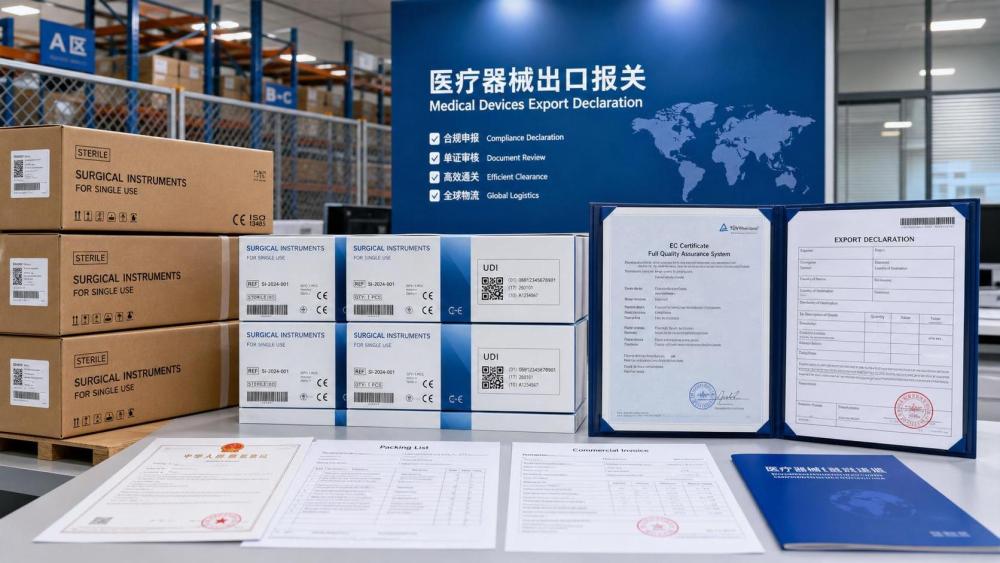
What the new customs declaration requirement confirms
According to the provided information, the General Administration of Customs of China announced on July 16, 2026 that, from August 1, 2026, all medical device export customs declarations must simultaneously report two items in the “Additional Information” field: the UDI-DI code for the target market and the valid medical device registration certificate number for that destination country. The examples provided include FDA 510(k) numbers, UKCA certificate numbers, and SFDA registration numbers. The stated purpose of the measure is to strengthen export traceability and coordination with overseas regulatory oversight.
The same information also confirms that the change directly affects the pace of technical documentation delivery to overseas customers as well as the preparation cycle for export paperwork by Chinese manufacturers.
Where the operational impact is likely to appear first
Documentation teams face tighter pre-shipment alignment
From an industry perspective, manufacturers and export trading entities are likely to feel the impact first in document preparation. Because customs declarations now need destination-market UDI-DI information and a valid registration certificate number, export files can no longer rely only on standard shipment details. The immediate pressure point is whether those identifiers are available, verified, and matched to the shipment before declaration.
Regulatory and market access functions become more closely tied to customs filing
Analysis shows that the requirement pulls regulatory information closer to the export execution stage. Teams responsible for overseas registrations, labeling data, and market access may need to coordinate more directly with customs, logistics, or order management personnel. The practical issue is not only whether a product is registered, but whether the relevant registration reference can be accurately embedded into the declaration workflow at the right time.
Supply chain service providers may see more dependency on client data quality
For customs brokers, freight coordinators, and other supply chain service providers, the change may shift part of the risk to data completeness and timing. If exporters or overseas customers do not provide the required identifiers early enough, filing schedules and document turnaround may be affected. What deserves closer attention is the handoff point between commercial shipment preparation and compliance data collection.
Overseas buyers may indirectly affect shipping rhythm
Observably, overseas customers may also influence execution speed because technical documentation delivery and registration-related references often depend on cross-border coordination. Where customer-side confirmation or document matching is slow, exporters may need to adjust internal sequencing for order release and declaration readiness.
What companies should track in practice
Whether internal document sets already capture the required fields
Companies should first check whether current export documentation workflows already collect target-market UDI-DI codes and valid destination-country registration certificate numbers in a format usable for customs declaration. The key issue is operational readiness rather than general compliance awareness.
How registration references are matched to each export destination
Where products move across different markets, the practical focus should be on matching the correct registration reference to the correct destination country. The provided examples make clear that the registration identifier is market-specific, so teams should pay attention to consistency between shipment destination, technical files, and declaration entries.
How much extra lead time is needed before filing
Because the provided information states that the measure affects technical document delivery rhythm and paperwork preparation cycles, companies should closely watch whether current lead times remain realistic. This is particularly relevant for businesses that finalize customer documents close to shipment dates.
Whether further official clarification changes execution details
Analysis shows that the policy signal is clear, but companies should continue monitoring whether later official language, filing guidance, or implementation clarifications refine how these fields must be completed in practice. The distinction between a stated requirement and day-to-day filing execution is one of the main issues to watch.
Why this looks like more than a one-off form update
Observably, this development should not be read only as an extra data-entry step. Based on the provided information, the measure links export declarations more directly with destination-market traceability and regulatory identifiers. That suggests a stronger connection between customs processes, overseas compliance information, and document control at shipment stage.
At the same time, it is more appropriate to understand this as an operational and regulatory signal rather than a finished outcome with all implications settled. The confirmed facts establish a new filing obligation, but the broader effect on timelines, internal responsibilities, and customer coordination will depend on how companies adapt their workflows.
How the industry may best interpret the change now
At this stage, the update is best understood as an immediate compliance requirement with broader workflow implications. The confirmed change is already concrete in its filing expectation, while the full business impact still needs to be observed through implementation. For the medical device export chain, the main significance lies in how customs data, regulatory documentation, and shipment execution now need to align more closely than before.
Basis of this article and ongoing verification points
This article is based on the user-provided news title, event date, and event summary. For this type of industry update, commonly relevant source categories may include official government announcements, company disclosures, industry association notices, authoritative media coverage, and standards-related documents. A specific official source link was not provided in the input, so the exact reference link still requires continued verification. Follow-up attention should remain on any later official clarification related to filing language, implementation details, and practical declaration handling.
Have questions about the global trade trends discussed here, or planning your expansion and supply chain strategy? Leave a message below and let the trade experts at MTHH guide you.
We respect your privacy. Your information is strictly confidential.
Related News
- FDA Issues Benefit-Risk Discussion Paper on Robotic Medical DevicesNov 07, 2026Explore the FDA discussion paper on robotic medical devices, its potential benefit-risk implications, and what manufacturers and purchasers should monitor.
- How to select ISO standards for medical device performance evaluationNov 06, 2026Choose medical device performance evaluation ISO standards with confidence. Learn to match claims, test methods, and regulatory requirements to reliable evidence.
- FDA Updates QMSR FAQs and Medical Device Cybersecurity GuidanceNov 06, 2026FDA QMSR FAQs and medical device cybersecurity guidance: Explore potential implications for ISO 13485 alignment, compliance planning and supplier coordination.
- Philips Reaches €288 Million Settlement in US Respiratory Device Recall ProbeNov 05, 2026Philips reaches a €288 million US settlement over its respiratory device recall. Explore the financial impact and implications for manufacturers.