
Singapore HSA Requires ISO 13485:2025 for Dental Imaging Imports
On June 29, 2026, Singapore’s Health Sciences Authority (HSA) announced an immediate change to import licensing for dental imaging equipment. Companies seeking permits for products such as dental X-ray systems, CBCT units, and intraoral scanners must now submit an ISO 13485:2025 quality management system certificate issued by an IAF-accredited body, while the 2016 version is no longer accepted. For dental device exporters, importers, and market-entry teams, this is worth close attention because it directly affects documentation readiness and the speed of access to the Singapore market, with likely implications for companies using Singapore as part of a broader Southeast Asia expansion path.
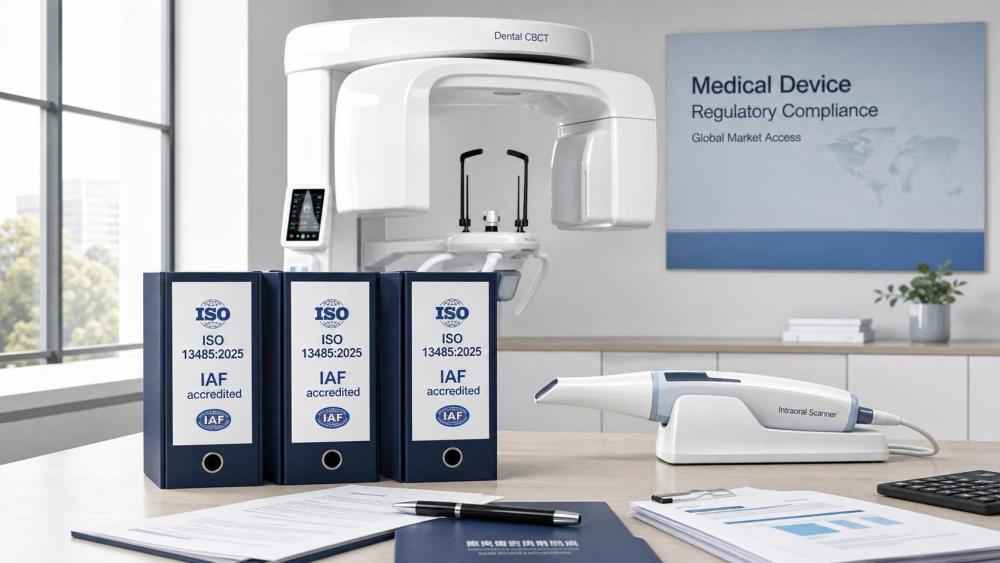
What the HSA announcement changes immediately
According to the information provided, the HSA issued its announcement on June 29, 2026, and the requirement took effect from the moment of publication. The change applies to companies applying for import permits for dental imaging devices, including dental X-ray equipment, CBCT, and intraoral scanners.
The key document now required is an ISO 13485:2025 certificate issued by an IAF-accredited body. The earlier ISO 13485:2016 certificate is no longer accepted for these import permit applications.
The provided summary also makes clear that this adjustment affects the ability of Chinese dental equipment exporters to achieve rapid market access in Southeast Asia.
Where the operational pressure is likely to appear
Export teams handling market entry documents
From an industry perspective, direct trading companies and export teams are likely to feel the impact first because the change is tied to import permit filing rather than a later-stage commercial step. The main pressure point is document completeness at the time of application. What deserves closer attention is whether existing compliance files still rely on ISO 13485:2016 and how quickly those files can be updated for shipments or applications already in preparation.
Manufacturers supplying dental imaging equipment
Analysis shows that manufacturers of dental X-ray systems, CBCT devices, and intraoral scanners may be affected through certification status, product launch timing, and coordination with overseas partners. If a manufacturer has not yet aligned its quality management documentation with ISO 13485:2025, the impact is likely to appear in export scheduling, distributor support, and customer commitments linked to planned import applications.
Distributors and channel partners in the import process
Distributors and other channel-side participants may be affected because they often rely on manufacturer-issued compliance materials when preparing import submissions. The practical issue is less about sales intent and more about whether the required certificate is available, valid in the required version, and issued by an IAF-accredited body. For this group, the immediate focus is likely to be communication with upstream suppliers and verification of submission documents before filing.
Supply chain and delivery coordination functions
Observably, supply chain service providers and delivery planning teams may also need to pay attention where import timing depends on license approval. If documentation is incomplete under the new rule, the effect could appear in shipment sequencing, delivery commitments, and customer-facing timelines. The change therefore reaches beyond compliance staff and into execution planning.
What companies should watch right now
Check certificate version against active applications
The first practical issue is whether any current or near-term import permit applications for dental imaging equipment still depend on ISO 13485:2016 documentation. Because the summary states that the older version is no longer accepted, companies should treat version matching as an immediate filing issue rather than a background compliance matter.
Confirm the issuing body meets the stated condition
The announcement, as summarized in the input, specifies that the certificate must be issued by an IAF-accredited body. Companies should therefore focus not only on the certificate version but also on whether the issuing organization matches that stated condition in the materials used for submission and customer communication.
Separate policy wording from filing execution
Analysis shows that a rule change can be clear in principle while still creating practical questions in day-to-day execution. For businesses involved in Singapore filings, the immediate task is to translate the published requirement into document control, submission preparation, and internal review steps, especially for applications already being assembled when the rule took effect.
Prepare customer and partner communication early
For exporters and distributors, customer communication may become a near-term issue where delivery plans were built around rapid market entry. What deserves closer attention is how to explain any documentation-related delay or adjustment without overstating outcomes that have not yet materialized in a specific case.
Why this matters beyond a single paperwork update
Observably, this development is more than a routine document revision because the requirement applies immediately and makes a specific certificate version a precondition for import licensing in the covered product categories. Analysis shows that the most important signal at this stage is procedural: regulatory access for dental imaging equipment can be slowed or interrupted when certification updates lag behind rule changes.
It is more appropriate to understand this as an immediate operational change with broader regional significance, rather than as a fully defined long-term market outcome. The provided information supports close attention to market-entry readiness, but it does not by itself confirm how far the effect will extend beyond the current licensing requirement.
How this update is best understood at this stage
At present, this HSA move is best read as a concrete compliance threshold that directly affects import applications for dental imaging equipment in Singapore. For companies connected to exports, distribution, and permit preparation, the significance lies in execution speed and documentation readiness rather than in broad market conclusions. A neutral reading is that the change has immediate practical consequences and should continue to be monitored as companies assess its effect on actual filing timelines and Southeast Asia market access plans.
About the basis of this article
This article is based on the user-provided news title, event date, and event summary regarding the HSA announcement dated June 29, 2026. For this type of industry update, commonly relevant source categories may include official regulatory announcements, company disclosures, industry association releases, authoritative media reports, and standard-setting organization documents.
A specific official source link was not provided in the input, so that point still requires ongoing verification. Continued attention should focus on any further official wording, implementation clarifications, and how the requirement is applied in actual import permit submissions for covered dental imaging devices.
Have questions about the global trade trends discussed here, or planning your expansion and supply chain strategy? Leave a message below and let the trade experts at MTHH guide you.
We respect your privacy. Your information is strictly confidential.
Related News
- How to choose dental radiography for clinic that fits your workflowAug 16, 2026Dental radiography for clinic selection starts with workflow, not specs. Learn how to compare intraoral, panoramic, and CBCT options for better efficiency, fit, and ROI.
- What FDA Cleared Dental Imaging Systems Mean for Daily PracticeJul 16, 2026Dental imaging systems FDA cleared: learn what clearance really means for workflow, compliance, training, and long-term value before choosing the right system for your practice.
- ANVISA Tightens AI Filing Path for Dental ImagingJul 15, 2026ANVISA tightens AI filing path for dental imaging in Brazil. Learn how the new Clinical Equivalence Report rule affects compliance, registrations, shipments, and market access.
- ANVISA Tightens AI Filing Rules for Dental ImagingJul 14, 2026ANVISA tightens AI filing rules for dental imaging in Brazil. Learn how the new requirements affect CBCT, intraoral X-ray, and panoramic system approvals, timelines, and market entry.