
How to choose dental radiography for clinic that fits your workflow
It often starts with a familiar procurement discussion: the clinic needs a dental imaging upgrade, but nobody agrees on what “fit” really means. One person focuses on image sharpness, another on budget, another on whether the unit can be installed without disrupting chairs, walls, and daily appointments. Then the conversation gets stuck between panoramic, intraoral, and CBCT options, and the team realizes the problem is not just choosing a machine. The real issue is choosing dental radiography for clinic use that matches the way people already work, or the way they need to work next.
This becomes more frustrating when the equipment looks comparable on paper. Two systems may both claim digital workflow, compact design, and diagnostic imaging support, yet one creates repeated patient repositioning, slower turnover, more operator correction, and heavier service dependence. If you are reviewing options from a technical and operational angle, the better decision usually comes from mapping the clinic’s workflow first and the specifications second.
Many selection mistakes happen because imaging is treated as a standalone purchase. In real clinical settings, radiography affects appointment flow, room utilization, retake risk, staff training, data transfer, maintenance planning, and even referral patterns. That is why a useful evaluation process begins with the points where the clinic already experiences friction.
Start from the moments where work slows down
A practical review usually begins by looking at the moments staff lose time or confidence. In some clinics, intraoral imaging is easy enough, but panoramic exams become a bottleneck because positioning takes too long or image review happens on a separate workstation. In other clinics, the issue is that a general dental practice starts seeing more implant, orthodontic, or surgical planning needs, and the existing 2D setup no longer supports efficient case assessment. Sometimes the clinic does not need a more advanced modality right away, but it does need a more reliable digital chain from image capture to viewing.
These situations look different, but they point to the same question: where does the current process fail? Not in theory, but in the sequence of real tasks. Patient arrives, operator prepares the room, image is taken, image is reviewed, image is stored, and the next patient enters. If the radiography system interrupts this sequence at multiple points, the problem is workflow mismatch rather than just equipment age.
That is also why choosing dental radiography for clinic environments cannot be reduced to “buy the highest image quality available.” A very advanced system may create unnecessary complexity in a practice that mainly needs fast routine diagnostics. On the other hand, a basic setup may become limiting if the clinic depends on broader maxillofacial assessment or treatment planning that increasingly requires 3D information.
Where buyers often misjudge the selection
One common mistake is comparing systems by modality category alone. Intraoral, panoramic, cephalometric, and cone beam CT each serve different clinical purposes, but the decision is rarely just about naming the modality. The more useful question is how often each imaging task occurs, who performs it, and whether the clinic needs that capability in-house or can reasonably refer it out.
Another mistake is assuming the “future-proof” option is always the most comprehensive one. A clinic can overbuy. If operator skill, patient demand, room readiness, and software management are not aligned with the added functionality, the result may be underused equipment with higher maintenance expectations and a longer learning curve.
A third misjudgment comes from ignoring installation realities. Dental radiography for clinic selection should include wall strength, floor area, shielding considerations, patient movement paths, monitor placement, and cable or network routing. Many workflow problems appear after installation, not before, when the unit technically fits the room but does not fit the room’s movement logic.
There is also a quieter issue: service complexity. Some clinics accept features they like during demonstration but do not fully examine calibration routines, detector handling, software updates, downtime procedures, and local support responsiveness. A system that seems efficient in the showroom can become disruptive if basic recovery steps are unclear when problems happen during a busy schedule.
A better way to compare options
Instead of starting with brand comparisons or feature catalogs, break the evaluation into five practical layers: clinical scope, room conditions, user operation, digital integration, and support burden. This makes comparison more grounded and less vulnerable to marketing language.
Clinical scope should be tied to actual imaging demand
If the clinic mostly handles routine restorative, periodontal, and endodontic work, high-quality intraoral imaging and possibly panoramic capability may cover most needs. If treatment planning increasingly includes implant placement, impacted teeth assessment, airway review, or complex anatomical relationships, a 3D option may become relevant. The point is not to chase the broadest imaging range. The point is to check whether the radiography format supports the decisions clinicians need to make without adding routine complexity where it is not necessary.
Ask whether the clinic needs single-tooth detail most of the time, full-jaw overview at moderate frequency, or occasional volumetric data for advanced planning. If the advanced need is occasional, referral may still be more efficient. If it is frequent enough to interrupt case flow, in-house expansion may be justified.
The room may approve or reject your shortlist before the team does
Space planning is often treated as a later step, but it should filter the shortlist early. Wall-mounted intraoral systems, panoramic units, and CBCT systems impose different installation and movement requirements. A clinic with limited space may not only need a smaller footprint; it may need easier patient entry, simpler head positioning, and less obstruction around existing furniture or cabinetry.
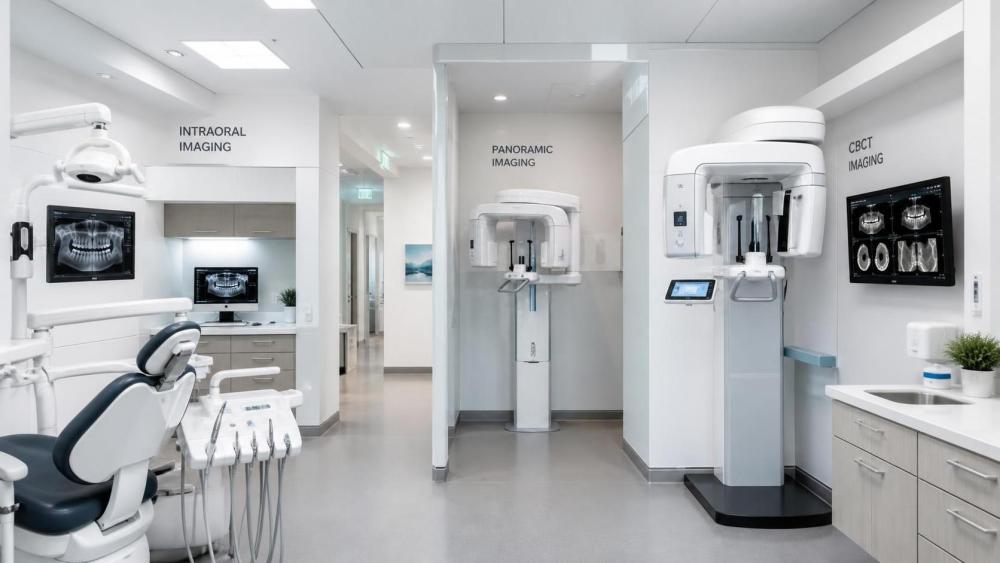
Look at how the patient stands or sits, how the operator moves around the device, and where the control interface is placed. If an assistant has to leave the room repeatedly to manage software or verify exposure settings, the workflow cost accumulates. Even small design choices can affect turnover and retake probability.
Operator consistency matters more than impressive feature depth
A technically rich system is only useful if different staff members can produce reliable images with reasonable consistency. During evaluation, pay attention to the number of positioning steps, clarity of interface prompts, exposure selection logic, and how easy it is to repeat a standard exam without hesitation.
If the clinic has variable staff experience, simple operation may be more valuable than advanced customization. A unit that reduces positioning confusion, shortens setup time, and makes image verification straightforward will often support better daily performance than one that offers many options rarely used in practice.
This is especially important when selecting dental radiography for clinic teams that include rotating operators, part-time staff, or periods of schedule pressure. Workflow stability depends on repeatability, not only capability.
Software fit is not a side note
Digital imaging systems can appear similar until you examine how images are transferred, labeled, reviewed, and stored. If the clinic already uses practice management software, imaging software, or a shared network environment, the new radiography system should be evaluated for compatibility and daily convenience, not just technical possibility.
Questions worth raising include whether image access is fast from treatment rooms, whether export and archive processes are simple, whether operators can review images immediately without switching through multiple screens, and whether updates or licensing arrangements create extra IT dependence. When software is awkward, image quality alone does not save the workflow.
Service expectations should be evaluated before procurement approval
It helps to ask who handles preventive maintenance, what the usual response path is for faults, whether remote support is available, and how detector or sensor replacement is managed. This is not about predicting failure; it is about understanding operational resilience. Clinics that depend heavily on in-house imaging need a clear plan for downtime because even temporary disruption can ripple into diagnosis, treatment planning, and appointment scheduling.
Matching modality to clinic reality
For many clinics, the practical decision is not between “good” and “better,” but between “sufficient and efficient” versus “more capable but more demanding.” That distinction matters.
Intraoral digital radiography usually makes sense where quick chairside diagnostics are the main need. It tends to support routine workflows well, especially when image capture, display, and storage are streamlined. The main evaluation points are sensor or plate handling, operator comfort, image clarity for common cases, and software responsiveness.
Panoramic imaging becomes relevant when the clinic regularly needs broader anatomical overview, treatment presentation support, orthodontic records, or pre-procedural screening beyond localized views. But the value depends heavily on positioning efficiency and image consistency. If repositioning errors are likely in your patient population or staffing pattern, that operational reality should weigh heavily in selection.
CBCT or combined panoramic and CBCT systems may be suitable where planning complexity genuinely requires 3D assessment often enough to justify in-house operation. The technical review should go beyond the presence of 3D capability and examine field of view flexibility, workflow impact, training needs, radiation management approach, and whether the clinic has a clear imaging use pattern rather than aspirational demand.
A combined unit can look attractive because it appears to cover current and future needs. Sometimes that is reasonable. Sometimes it leads to paying for complexity the clinic will use inconsistently. The deciding factor should be procedural fit, not fear of being left behind.
Questions that help separate a workable option from a disruptive one
When teams get stuck between similar products, it helps to bring the discussion back to use conditions:
Which image types are needed every day, and which are occasional?
Can operators complete common exams without extended setup or repeated corrections?
Will the system fit current room layout without creating movement conflicts?
Can clinicians review images quickly in the places where decisions are made?
Does the clinic have the staff readiness to manage a more advanced modality well?
What happens operationally if the unit or software is temporarily unavailable?
These are not dramatic questions, but they usually reveal more than a long specification sheet. They also help prevent a selection process from turning into an abstract comparison exercise disconnected from daily use.
Making the final decision without overcomplicating it
If you are trying to narrow options, it can help to write a short internal use profile rather than a long requirement document. Keep it practical: patient volume pattern, typical procedures, room constraint notes, operator experience level, software environment, and expected maintenance tolerance. Then compare every candidate system against that profile.
The best choice for dental radiography for clinic use is often the one that causes the fewest avoidable interruptions while still meeting diagnostic needs. That may be a straightforward digital intraoral upgrade, a panoramic system that integrates well with current workflow, or a broader imaging platform if the clinic’s clinical scope clearly supports it. A strong selection is rarely the most impressive option in isolation. It is the one that fits the clinic’s real behavior, not its imagined future version.
When technical evaluation is done this way, the discussion becomes clearer. Image quality still matters. So do dose management, software, room planning, and service support. But instead of treating them as separate buying criteria, you can see them as parts of one question: will this system help the clinic work more reliably day after day? That is usually the point where a difficult comparison becomes a decision.
Have questions about the global trade trends discussed here, or planning your expansion and supply chain strategy? Leave a message below and let the trade experts at MTHH guide you.
We respect your privacy. Your information is strictly confidential.
Related News
- How to choose dental radiography for clinic that fits your workflowAug 16, 2026Dental radiography for clinic selection starts with workflow, not specs. Learn how to compare intraoral, panoramic, and CBCT options for better efficiency, fit, and ROI.
- What FDA Cleared Dental Imaging Systems Mean for Daily PracticeJul 16, 2026Dental imaging systems FDA cleared: learn what clearance really means for workflow, compliance, training, and long-term value before choosing the right system for your practice.
- ANVISA Tightens AI Filing Path for Dental ImagingJul 15, 2026ANVISA tightens AI filing path for dental imaging in Brazil. Learn how the new Clinical Equivalence Report rule affects compliance, registrations, shipments, and market access.
- ANVISA Tightens AI Filing Rules for Dental ImagingJul 14, 2026ANVISA tightens AI filing rules for dental imaging in Brazil. Learn how the new requirements affect CBCT, intraoral X-ray, and panoramic system approvals, timelines, and market entry.